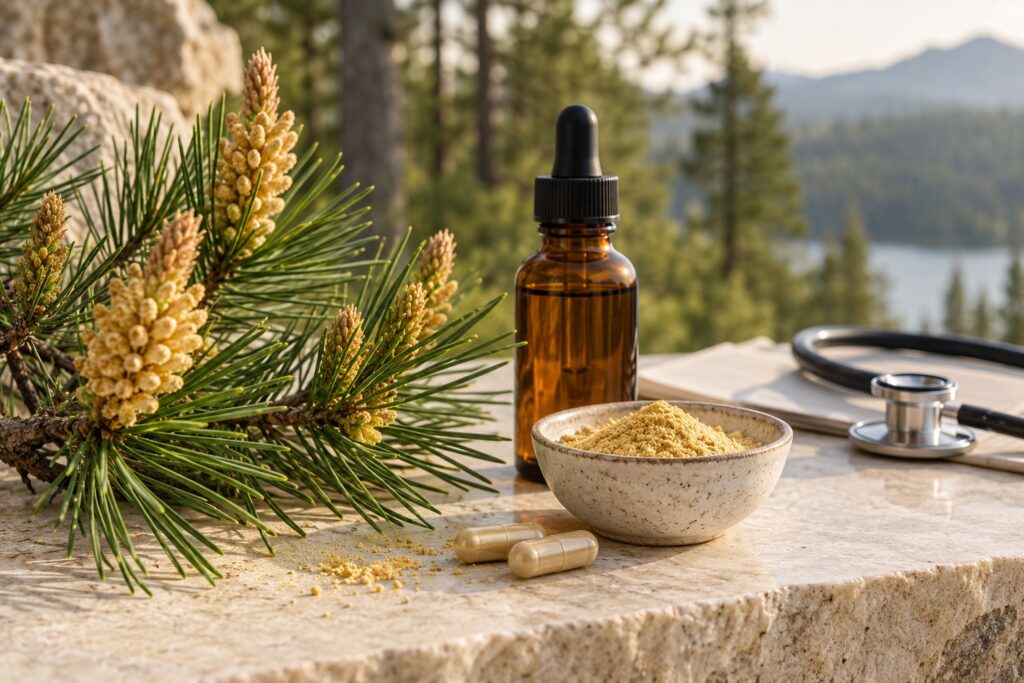

With that much pollen in the environment, you might expect pine to be one of the major causes of seasonal allergy.
Curiously, it is not.
Pine pollen allergy is considered relatively uncommon compared with many other pollen allergies. But uncommon does not mean impossible. Pine pollen can provoke genuine allergic reactions in sensitized people, and research has identified several allergenic proteins shared across different Pinus species. The American College of Allergy, Asthma & Immunology recognizes pine pollen as a potential cause of seasonal allergy and notes that symptoms resemble other forms of pollen allergy.
The more difficult question concerns pine pollen supplements.
What happens when pollen from Pinus massoniana (Masson pine) is swallowed as powder or taken as a tincture?
Here, the evidence becomes much thinner.
Key Takeaways
- Pine pollen can cause genuine IgE-mediated allergy, although respiratory pine pollen allergy appears to be relatively uncommon.
- Strong cross-reactivity has been demonstrated among several Pinus species, but Pinus massoniana was not directly tested in the major 2009 study.
- Pine nut allergy and pine pollen allergy are different conditions, although cross-reactivity has been documented in individual cases.
- The frequency of allergic reactions caused by swallowed pine pollen supplements is not well established.
- Cracked-cell processing and tincture extraction have not been shown to eliminate allergy risk.
- Anyone with a history of serious allergy should not test pine pollen tolerance through an unsupervised home trial.
Emergency Warning
Trouble breathing, throat or tongue swelling, dizziness, fainting, or other signs of a severe allergic reaction may indicate anaphylaxis and require immediate emergency care. Use prescribed epinephrine and call 911.
Table of Contents
- An Allergy Begins With a Mistaken Identity
- Pine Pollen Contains Proteins the Immune System Can Recognize
- Airborne Pine Pollen Allergy Is Well Established
- Why So Much Yellow Pollen Causes Surprisingly Few Allergies
- Different Pine Species Can Cross-React
- Where Does Pinus massoniana Fit?
- Breathing Pollen and Eating Pollen Are Different Exposures
- Can Pine Pollen Powder Cause an Allergic Reaction When Swallowed?
- Powder and Tincture Are Not the Same Allergy Exposure
- Pine Nut Allergy Is Not the Same Thing as Pine Pollen Allergy
- Cross-Reactivity Between Pine Nut and Pine Pollen Has Been Demonstrated
- Sensitization and Allergy Are Not Quite the Same Thing
- Grass Pollen Allergy Does Not Automatically Mean Pine Allergy
- What Symptoms Deserve Particular Attention?
- People With Certain Allergy Histories Should Be More Cautious
- How Allergists Investigate Suspected Allergy
- “Just Start With a Tiny Amount” Is Poor Advice for Suspected Serious Allergy
- Does Cracked-Cell Pine Pollen Change the Allergy Risk?
- Does Alcohol Extraction Remove Pine Pollen Allergens?
- Pine Pollen Allergy: What We Actually Know
- The Biggest Research Gap Is Oral Pine Pollen
- Natural Does Not Mean Invisible to the Immune System
- Frequently Asked Questions
- References and Further Reading
An Allergy Begins With a Mistaken Identity
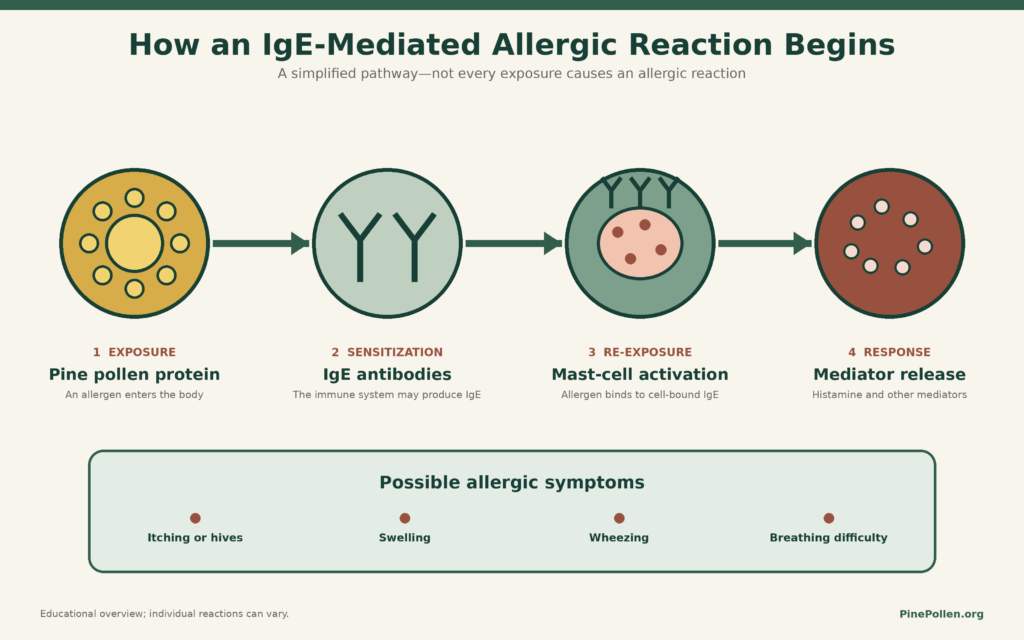
An allergic reaction occurs when the immune system responds to something that is normally harmless as though it were dangerous.
With many immediate allergies, an antibody called IgE, or immunoglobulin E, is involved.
The process often begins with sensitization. During an earlier exposure, the immune system learns to recognize a particular protein and produces IgE antibodies against it.
Those antibodies attach to immune cells called mast cells.
Mast cells are packed with chemical messengers, including histamine.
When the person encounters the allergen again, the protein can bind to IgE on the mast cells and trigger release of those chemicals.
The result may be itching, swelling, sneezing, hives, wheezing, or—in severe circumstances—a systemic reaction.
It is a little like installing a burglar alarm for someone who actually belongs in the house.
The protein is not inherently dangerous.
The immune response is the problem.
Pine Pollen Contains Proteins the Immune System Can Recognize
Pollen grains are microscopic male gametophytes containing proteins that the immune system may recognize.
It carries proteins needed for cellular metabolism, pollen development, germination, and ultimately fertilization.
Some of those proteins can behave as allergens—molecules capable of triggering an allergic response in sensitized people.
A 2009 study examined 65 people with documented pine pollen allergy. Researchers identified nine allergenic protein bands in Pinus radiata pollen. One protein region around 42 kilodaltons was recognized by IgE from 85% of the patients, while another smaller region was recognized by about 40%.
A kilodalton, or kDa, is simply a unit scientists use to describe molecular mass.
The exact numbers are less important than what the experiment demonstrated:
Pine pollen contains specific proteins that human IgE antibodies can recognize.
That is solid evidence that pine pollen can function as a true allergen.
Airborne Pine Pollen Allergy Is Well Established
For most allergic people, exposure occurs through the air.
Wind carries pine pollen into the nose, eyes, and respiratory tract.
Symptoms can resemble ordinary seasonal hay fever:
- Sneezing
- Runny nose
- Nasal congestion
- Itchy or watery eyes
- Cough
- Itching around the nose or eyes
In some susceptible people, pollen exposure can also aggravate asthma and contribute to wheezing or breathing symptoms.
Doctors call the classic nasal response allergic rhinitis—inflammation of the nasal passages caused by exposure to an allergen.
Pine pollen is therefore a legitimate seasonal allergen.
It simply appears to be a less common one.
Why So Much Yellow Pollen Causes Surprisingly Few Allergies
This is one of the more interesting botanical puzzles.
Pines produce enormous quantities of pollen because they rely largely on wind for pollination.
There is no bee carefully carrying each grain to its destination.
Instead, the tree plays a numbers game.
Release millions upon millions of pollen grains and increase the odds that some reach a receptive female cone.
The result is highly visible.
But visibility does not equal allergenicity.
How strongly a pollen affects allergy depends on several factors, including:
- The proteins it contains
- How readily those proteins are released
- How much pollen reaches sensitive tissues
- Individual immune sensitization
- Regional exposure
- Cross-reactivity with other allergens
A yellow car hood therefore tells you that pine pollen is abundant.
It does not tell you that pine is causing your symptoms.
Other tree or grass pollens circulating at the same time may be responsible.
Different Pine Species Can Cross-React
One of the strongest findings in pine allergy research concerns cross-reactivity.
Cross-reactivity occurs when IgE antibodies developed against one allergen recognize a similar protein from another source.
Think of an antibody as a lock designed around a particular molecular key.
If another protein has a sufficiently similar shape, it may fit the same lock.
In the 2009 study of pine-allergic patients, researchers tested pollen from several species, including Pinus radiata, Pinus pinea (stone pine), Pinus sylvestris (Scots pine), and Pinus nigra (Austrian pine).
They found a high degree of cross-reactivity among the different pine pollens.
That is important.
Someone sensitized to one pine species may potentially recognize allergenic proteins from another.
Where Does Pinus massoniana Fit?
Pinus massoniana belongs to the same genus as the species involved in the cross-reactivity research.
That gives us a biologically reasonable reason to be cautious about assuming Masson pine pollen is completely unrelated allergically.
But there is an important limitation.
The major cross-reactivity study did not directly test Pinus massoniana.
And the clinical literature specifically examining allergy after oral consumption of *P. massoniana* pollen products remains limited.
So the responsible interpretation is:
Cross-reactivity among Pinus pollens is well demonstrated.
The precise allergenic profile and oral allergy risk of commercial Pinus massoniana products are much less well characterized.
Breathing Pollen and Eating Pollen Are Different Exposures
This distinction becomes especially important for pine pollen supplements.
Airborne pollen primarily encounters the:
- Nose
- Eyes
- Sinuses
- Airways
Swallowed pollen encounters the:
- Mouth
- Throat
- Stomach
- Intestines
That changes the biology considerably.
Proteins passing through the digestive tract encounter stomach acidity and digestive enzymes that may break them into smaller pieces.
Some proteins are readily degraded.
Others retain enough structure to be recognized by the immune system.
So knowing that someone has respiratory pine pollen allergy does not automatically tell us exactly what will happen if that person swallows pine pollen powder.
The exposure route matters.
Can Pine Pollen Powder Cause an Allergic Reaction When Swallowed?
Biologically, yes—it is possible.
Whole pine pollen powder contains pollen proteins, including proteins capable of functioning as allergens.
What we do not have is a large body of clinical studies documenting how frequently commercial pine pollen powders provoke oral allergic reactions.
That means we should distinguish possibility from prevalence.
The mechanism is plausible.
The frequency is poorly defined.
An IgE-mediated reaction to an ingested botanical allergen can potentially involve symptoms such as:
- Itching of the mouth or throat
- Hives
- Swelling
- Nausea or vomiting
- Wheezing
- Difficulty breathing
Those are general manifestations of allergic reactions and should not be interpreted as evidence that they commonly occur with pine pollen supplements.
The direct supplement-specific data are limited.
Powder and Tincture Are Not the Same Allergy Exposure
Whole pollen powder contains the physical pollen grain.
That means its proteins remain part of the product.
A tincture is different.
During hydroalcoholic extraction, selected compounds move from the pollen into a mixture of ethanol and water, while much of the solid material is later removed.
Extraction and filtration may change which proteins remain in the finished tincture, but the resulting allergen content has not been adequately characterized.
That leaves several important questions.
How much allergenic protein transfers into a pine pollen tincture?
Which proteins survive extraction?
Does filtration remove most of them?
Are smaller allergenic protein fragments still present?
At present, those questions are not well answered for commercial Pinus massoniana tinctures.
So it would be inappropriate to describe tinctures as “allergy free.”
Different format does not automatically mean zero risk.
Pine Nut Allergy Is Not the Same Thing as Pine Pollen Allergy
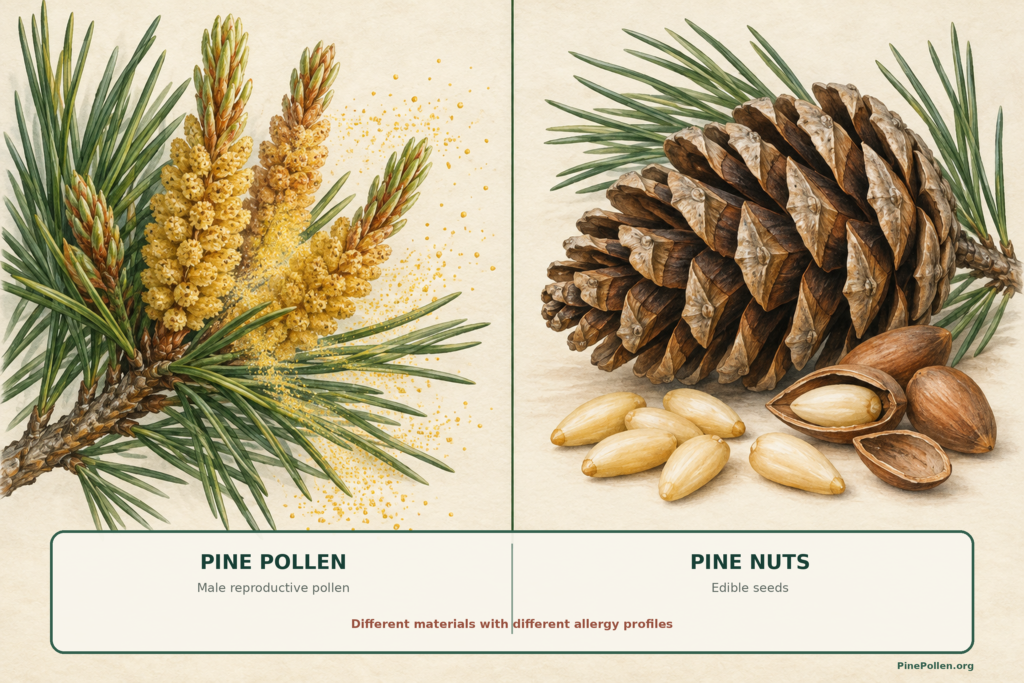
This is an easy distinction to miss because both products come from pine trees.
Pine nuts are seeds.
Pine pollen is male reproductive pollen.
They contain different mixtures of proteins and perform completely different jobs for the plant.
Pine nut allergy is a recognized food allergy and can cause severe reactions, including anaphylaxis. ACAAI treats pine nut and pine pollen allergy as separate concerns, while also noting that cross-reactivity has been reported between them.
So:
Pine nut allergy does not automatically mean pine pollen allergy.
And:
Pine pollen allergy does not automatically mean pine nut allergy.
But there is an interesting connection.
Cross-Reactivity Between Pine Nut and Pine Pollen Has Been Demonstrated
A 2000 case report examined a person with pine nut allergy.
Testing found specific IgE against both pine nut and pine pollen extracts.
Researchers then performed immunoblot inhibition experiments—a laboratory method that can help determine whether antibodies recognize related proteins in two different allergen sources.
They found cross-reacting components between the pine nut and pine pollen extracts.
Interestingly, the patient had no clinical symptoms from pine pollen despite having IgE that recognized it.
That observation teaches us two things.
First, pine nut and pollen proteins can overlap enough for cross-reactivity to occur in at least some people.
Second, laboratory sensitization does not necessarily equal clinical allergy.
Sensitization and Allergy Are Not Quite the Same Thing
A person can have detectable IgE antibodies against an allergen without developing obvious symptoms when exposed.
That is called sensitization.
Clinical allergy requires the exposure to produce symptoms.
The distinction matters when interpreting skin-prick or blood testing.
A positive test tells an allergist that the immune system recognizes the material.
It does not perfectly predict:
- Whether symptoms will occur
- How severe they will be
- Which route of exposure will cause them
Clinical history remains essential.
This is exactly what the pine nut–pine pollen case demonstrated: laboratory cross-reactivity existed even though the patient did not experience pine pollinosis.
Grass Pollen Allergy Does Not Automatically Mean Pine Allergy
People with seasonal allergies are often sensitized to more than one pollen.
In the 2009 pine allergy study, 51% of participants were also sensitized to grass pollen.
Researchers found some cross-reactivity between pine and grass pollen, but it was only partial and appeared in people already sensitized to the grass Lolium perenne (perennial ryegrass).
So having grass pollen allergy does not establish pine allergy.
People can simply have several independent environmental allergies at the same time.
What Symptoms Deserve Particular Attention?
Mild pollen allergy often looks familiar:
- Sneezing
- Runny nose
- Itchy eyes
- Nasal congestion
- Mild cough
An oral allergic reaction may look different.
Symptoms such as widespread hives, swelling of the lips or tongue, repeated vomiting, wheezing, throat tightness, difficulty breathing, dizziness, or fainting deserve much more attention.
A severe systemic allergic reaction is called anaphylaxis.
Anaphylaxis can involve several organ systems and may progress rapidly.
Difficulty breathing, throat swelling, faintness, or other signs of a severe allergic reaction require emergency medical care.
How Allergists Investigate Suspected Allergy
Several tools may be used depending on the situation.
Skin-prick testing
A small amount of allergen is introduced superficially into the skin and the response is observed.
Specific-IgE blood testing
A laboratory measures IgE antibodies directed against a particular allergen.
Component testing
Some modern allergy diagnostics look for IgE directed against specific proteins rather than an entire crude allergen extract.
Supervised challenge
In selected food-allergy situations, an allergist may expose a patient to controlled amounts under medical supervision.
ACAAI specifically warns that food challenges should not be attempted independently because of the possibility of anaphylaxis.
Testing is interpreted alongside symptoms and exposure history.
No single number tells the entire story.
“Just Start With a Tiny Amount” Is Poor Advice for Suspected Serious Allergy
This suggestion appears frequently around supplements.
It is not appropriate for someone with a history of potentially serious allergy.
Highly sensitized individuals can react to small quantities.
A home experiment also provides none of the monitoring or treatment capabilities available during a medically supervised challenge.
If there is a realistic concern about IgE-mediated allergy, the safer question is not:
“How little should I try?”
It is:
“Do I need an allergy assessment before trying this at all?”
Does Cracked-Cell Pine Pollen Change the Allergy Risk?
We do not know.
Breaking the pollen wall exposes more of the internal pollen material.
In theory, that could alter exposure to internal proteins.
But there is not enough direct human research to say confidently whether cracked-cell pine pollen is more allergenic, less allergenic, or essentially equivalent to intact pollen when swallowed.
So claims in either direction would be premature.
“More digestible” does not automatically mean “less allergenic.”
The Biggest Research Gap Is Oral Pine Pollen
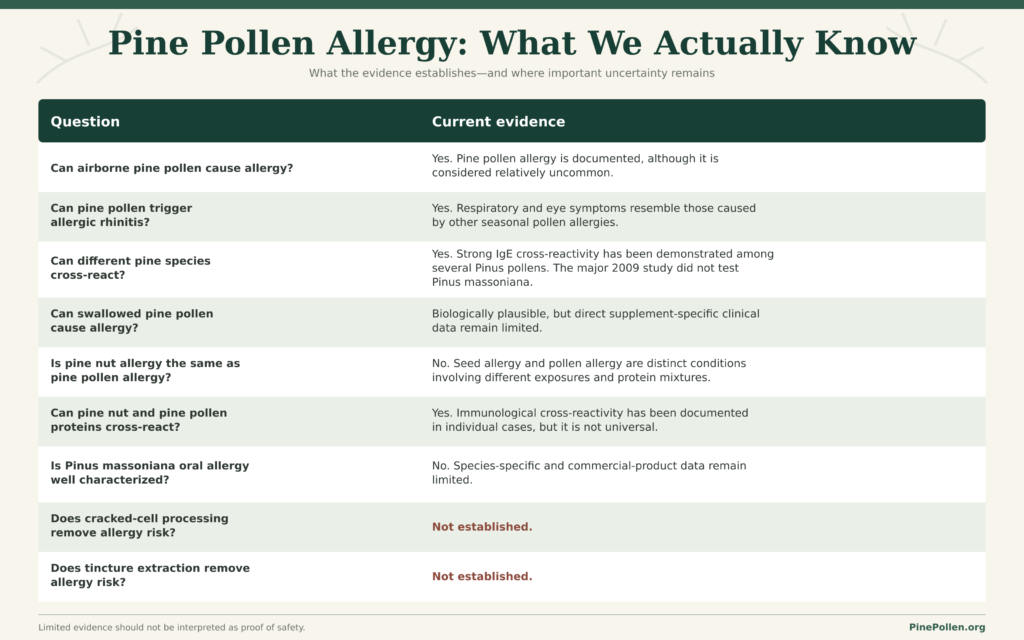
There is a striking imbalance in the evidence.
Scientists understand considerably more about inhaled pine pollen than intentionally consumed pine pollen products.
Future research could answer practical questions such as:
- Which proteins are the major allergens in Pinus massoniana pollen?
- How strongly do they cross-react with other pine species?
- Does cracking the pollen wall change IgE binding?
- How much intact allergenic protein remains in hydroalcoholic tinctures?
- Does pine nut allergy predict oral reactions to pine pollen in some individuals?
- How frequently do supplement users experience true IgE-mediated reactions?
Those studies would replace broad precautionary language with much more precise guidance.
For now, that precision is missing.
Natural Does Not Mean Invisible to the Immune System
Pine pollen is a beautifully specialized botanical structure.
Its proteins help a microscopic reproductive grain remain functional long enough to complete one of the most difficult journeys in a pine tree’s life cycle.
Most immune systems encounter those proteins without serious consequences.
A sensitized immune system may see something very different.
The evidence tells us that pine pollen can be a genuine allergen, that different pine pollens can cross-react strongly, and that some overlap with pine nut allergens is possible.
What science has not yet mapped nearly as well is the allergy risk created when concentrated pine pollen powders and extracts are intentionally consumed.
That uncertainty deserves neither alarm nor dismissal.
It deserves better research.
To a pine tree, pollen is a reproductive package; to an allergic immune system, the proteins inside that package can sometimes look like an alarm.
Frequently Asked Questions:
Is pine pollen a common seasonal allergen?
Pine pollen allergy is documented but considered relatively uncommon compared with many other seasonal pollen allergies. Pine produces highly visible yellow pollen, yet visibility does not identify the cause of a person’s symptoms. Grass and other tree pollens may circulate during the same period. An allergist can evaluate exposure history and determine whether testing is appropriate.
Can someone with a pollen allergy take pine pollen powder?
A general history of seasonal allergy does not prove that someone is allergic to pine. However, a person with known pine pollen allergy, pollen-related asthma, previous reactions to pine-derived products, or a history of serious allergic reactions should seek individualized medical advice before considering a pine pollen supplement. An unsupervised home trial is not an appropriate way to investigate suspected serious allergy.
Is pine pollen tincture safer for allergies than powder?
That has not been established. Powder retains the physical pollen material, while extraction and filtration change the composition of a tincture. However, there are insufficient product-specific data showing how much allergenic protein remains in commercial tinctures. A different format should not be interpreted as “allergy free.”
Does pine nut allergy mean someone is allergic to pine pollen?
No. Pine nuts are seeds, while pine pollen is male reproductive material, and the two contain different protein mixtures. Cross-reactivity has been demonstrated in individual cases, but it is not universal. Someone with severe pine nut allergy should discuss pine-derived supplements with an allergist rather than assuming either complete safety or automatic allergy.
Does cracked-cell processing remove pine pollen allergens?
There is not enough direct human evidence to say that cracked-cell pollen is more allergenic, less allergenic, or equivalent to intact pollen when swallowed. Mechanical processing exposes internal material but does not establish that allergenic proteins have been removed or rendered harmless.
What symptoms require emergency care?
Trouble breathing, throat or tongue swelling, wheezing, faintness, dizziness, or a rapidly progressing reaction can indicate anaphylaxis. Use prescribed epinephrine immediately and call 911. Antihistamines are not a substitute for epinephrine in anaphylaxis. Anyone who experiences a suspected serious reaction should receive urgent medical evaluation.
References and Further Reading
- Gastaminza G, et al. “Allergenicity and cross-reactivity of pine pollen.” Clinical & Experimental Allergy. 2009;39(9):1438–1446. View PubMed record
- Senna G, Roncarolo D, Dama A, Mistrello G. “Anaphylaxis to pine nuts and immunological cross-reactivity with pine pollen proteins.” Journal of Investigational Allergology and Clinical Immunology. 2000;10(1):44–46. View PubMed record
- American College of Allergy, Asthma & Immunology. “Pine Tree Allergy.” View patient guidance
- American College of Allergy, Asthma & Immunology. “Anaphylaxis.” View emergency guidance
- Asam C, Hofer H, Wolf M, Aglas L, Wallner M. “Tree pollen allergens—an update from a molecular perspective.” Allergy. 2015;70(10):1201–1211. View full text
- National Center for Complementary and Integrative Health. “Using Dietary Supplements Wisely.” View NCCIH guidance
Editorial and Medical Disclaimer
This article is provided for educational and informational purposes only. It is not medical advice and is not intended to diagnose, treat, cure, or prevent any disease. Pine pollen products may not be appropriate for everyone. Consult a qualified healthcare professional before using a dietary supplement, particularly if you have allergies, are pregnant or breastfeeding, take medication, or have a medical condition.
Related Reading
- Is Pine Pollen Safe? A Practical Safety Overview
- Pine Pollen and Asthma: What to Know
- Pine Nut Allergy vs. Pine Pollen Allergy
- Pine Pollen During Pregnancy and Breastfeeding
- Pine Pollen Side Effects and Possible Interactions
- How to Evaluate Contaminant Testing for Pine Pollen Products
PinePollen.org | Educational Article