At first glance, it can sound like an exotic ingredient rather than a tree. In reality, Pinus massoniana—better known as Masson pine—is a large, resinous pine native to parts of China, Taiwan, and northern Vietnam. It has played an important role in natural forests, commercial forestry, rural landscapes, and traditional plant use for generations.
It is also an impressive tree in its own right.
Long before anyone dried its pollen or bottled an extract, Masson pine was doing what pines have done for millions of years: colonizing open ground, producing clouds of windborne pollen, developing woody cones, and building forests.
Understanding the tree makes understanding its pollen much easier.
Key Takeaways
- Pinus massoniana, commonly called Masson pine, is an evergreen conifer native to parts of China, Taiwan, and northern Vietnam.
- It is one of the principal species associated with commercially harvested pine pollen, particularly in China.
- Its long needles usually grow in pairs, and its small pollen cones release large quantities of windborne pollen in spring.
- Masson pine is also an important forestry tree valued for timber, pulp, resin, and reforestation.
- Identifying the species and plant part does not establish that a pine pollen product has proven health effects.
Table of Contents
- What exactly is Pinus massoniana?
- Masson pine at a glance
- Where Masson pine grows
- What Masson pine looks like
- Needles, cones, and pollen
- Growing conditions
- Forestry and other uses
- Why the species matters for pine pollen
- Frequently asked questions
- References and further reading
First Things First: What Exactly Is Pinus massoniana?
Pinus massoniana Lamb. is an evergreen conifer in the pine family, Pinaceae.
Its accepted botanical classification places it in the genus Pinus, alongside familiar species such as Scots pine (Pinus sylvestris), Japanese black pine (Pinus thunbergii), and Chinese pine (Pinus tabuliformis).
Its best-known English common name is Masson pine, although it is also sometimes called horsetail pine.
Common names can vary among regions, languages, and sources. This is exactly why the scientific name matters.
When a supplier identifies its botanical material as Pinus massoniana, there is far less ambiguity about which tree is being discussed.
Masson Pine at a Glance
- Botanical name: Pinus massoniana Lamb.
- Common name: Masson pine
- Family: Pinaceae
- Genus: Pinus
- Plant type: Evergreen coniferous tree
- Native range: Parts of central and southern China, Taiwan, and northern Vietnam
- Needles: Usually two per bundle, occasionally three
- Pollination: Primarily by wind
- Typical pollen season: Spring
- Notable uses: Forestry, timber, pulp, resin, reforestation, and harvested pollen
A Pine Built for the Landscapes of Southern China
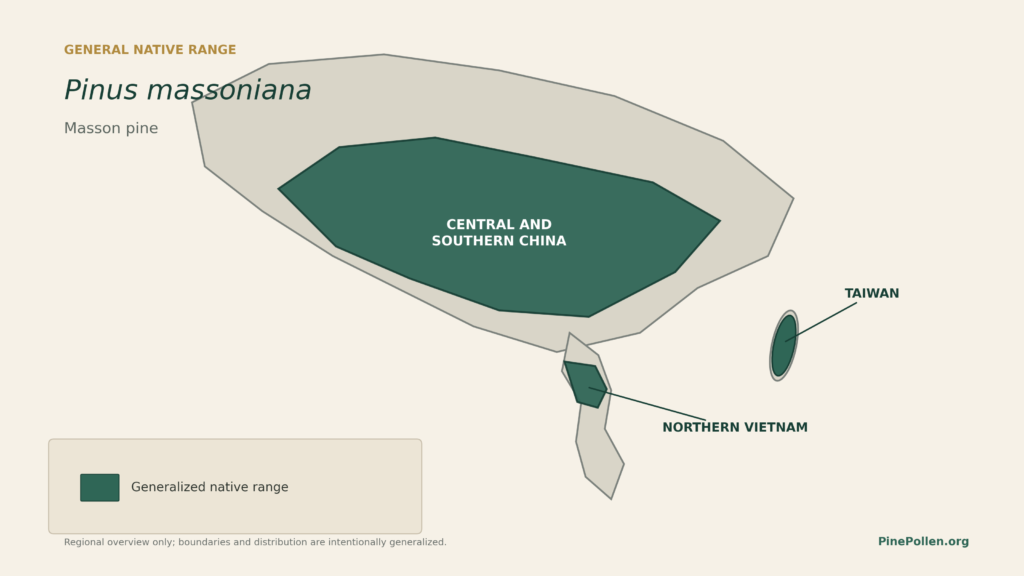
Masson pine is strongly associated with the warmer regions of China.
Its natural distribution extends across a broad area of central and southern China, as well as Taiwan and northern Vietnam. Rather than being a rare specialist confined to one isolated mountain valley, it is an important forest tree across a substantial geographic range.
The species grows from relatively low elevations into mountainous terrain. Flora of China records it from near sea level to approximately 2,000 meters.
That broad range points to one of the tree’s defining characteristics: adaptability.
Masson pine has become particularly important in forestry because it can establish itself where growing conditions are not especially favorable. It can be found on hillsides, disturbed land, open forests, and sites used for reforestation.
It is the sort of tree that can look entirely at home on a rugged slope where less adaptable plants might struggle.
What Does a Masson Pine Look Like?
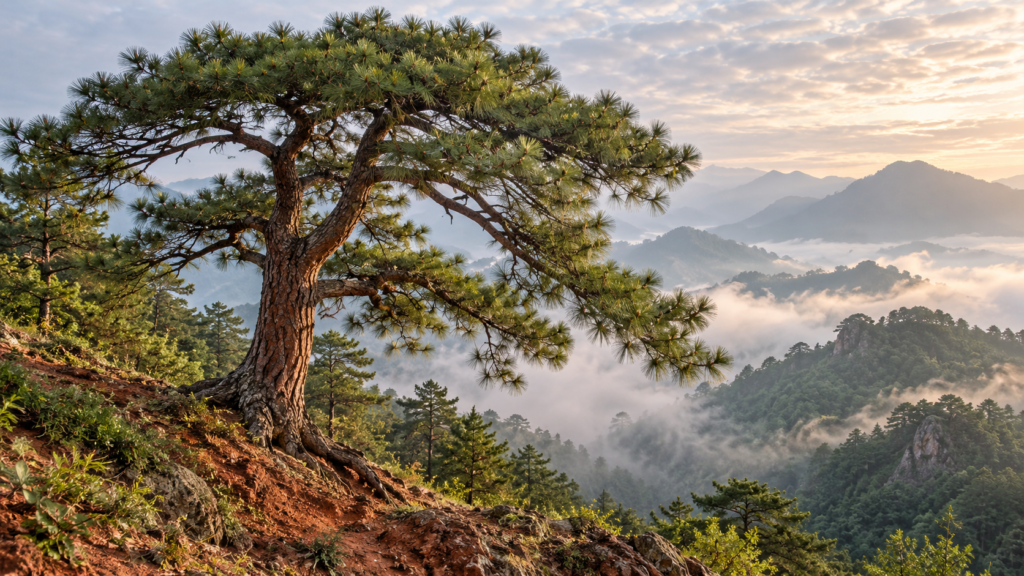
Young Masson pines tend to have the recognizable conical outline associated with many conifers.
As the tree ages, its shape can change considerably.
The crown may broaden and become irregular or almost umbrella-like. Mature specimens therefore do not always retain the symmetrical, Christmas-tree silhouette seen in younger trees.
Given enough time and favorable conditions, Pinus massoniana can become a substantial tree. Flora of China describes specimens reaching approximately 45 meters in height, with trunks approaching 1.5 meters in diameter.
The bark changes with age and position on the trunk.
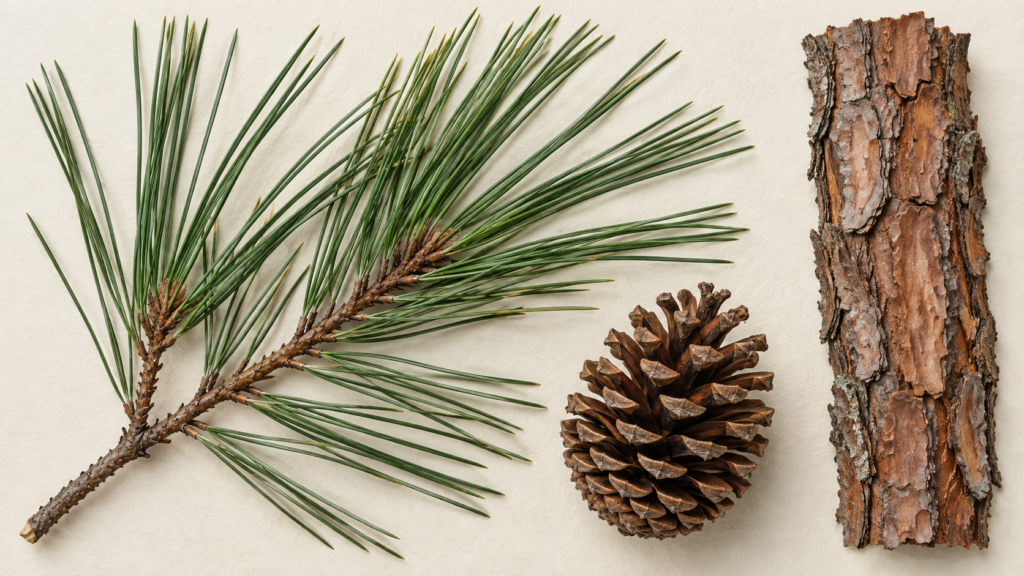
Higher portions of the tree may show reddish-brown tones, while the older bark near the base becomes grayish brown or reddish brown and breaks into irregular scales and flakes.
This gives mature trees a rugged appearance well suited to the landscapes they inhabit.
The Long Needles Give It Character
One of the easiest ways to appreciate a pine is to stop looking at the entire tree and examine a single branch.
Masson pine produces relatively long, slender needles, typically around 12–20 centimeters long.
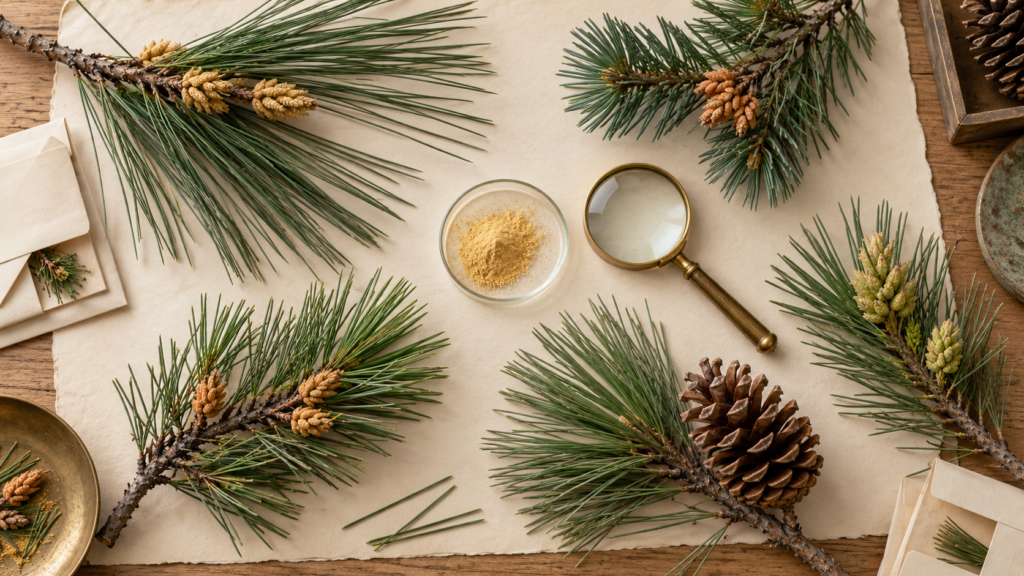
The needles usually grow two to a bundle, although groups of three can occasionally occur. Botanists call these bundles fascicles.
There is nothing mysterious about the term. If you gently separate the needles on a pine shoot, the small groups emerging together are the fascicles.
In Pinus massoniana, the long needles may be slightly twisted. They give the ends of the branches a softer, more flowing appearance than that seen in many short-needled pine species.
That characteristic helps explain the alternative name horsetail pine.
Before the Woody Pine Cone Comes a Different Kind of Cone
Ask someone to picture a pine cone and they will probably imagine the familiar brown, woody structure found on a forest floor.
That is the female seed cone.
Masson pine also produces male reproductive structures, which are especially important when discussing pine pollen.
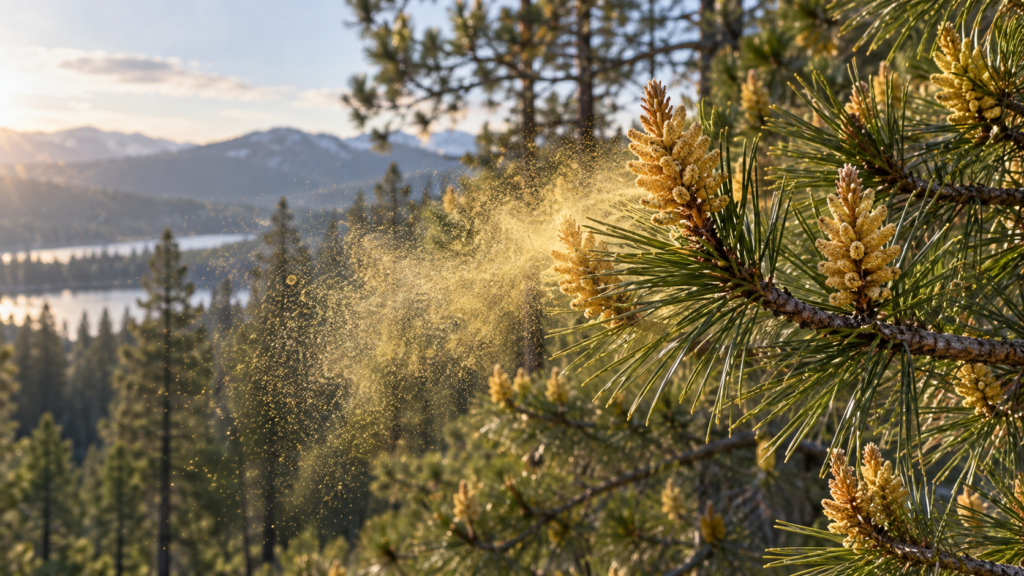
The male cones—more precisely called pollen cones or microstrobili—are much smaller and softer than mature seed cones. They develop in clusters and produce large numbers of pollen grains.
As they mature, they can give portions of a branch a yellowish appearance. When the conditions are right, the cones release their pollen and the wind takes over.
The Golden Cloud: How Pinus massoniana Produces Pollen
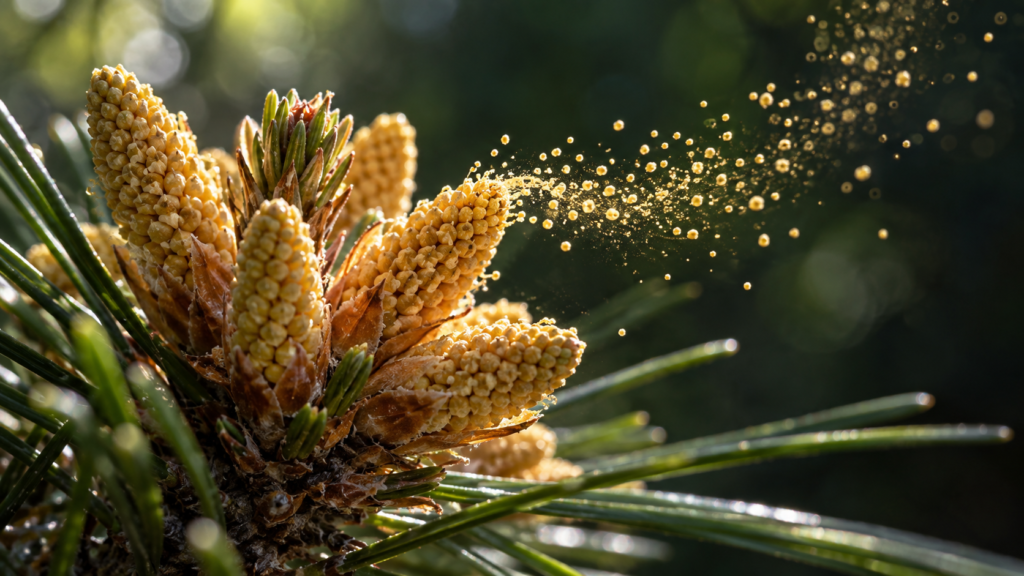
Masson pine does not depend primarily on bees or butterflies to carry its pollen. It relies on wind pollination.
Unlike an insect that can move directly between flowers, wind has no particular destination. The tree compensates by producing and releasing pollen in enormous quantities.
When many mature pollen cones release their pollen at roughly the same time, clouds of fine yellow material can move through the surrounding air. Only a small fraction needs to reach receptive female cones for pollination to occur.
Flora of China places the pollination period of Pinus massoniana primarily in April and May, although the exact timing varies with location, elevation, and seasonal weather.
This short seasonal window also makes harvesting pine pollen highly dependent on timing.
Too early, and the pollen may not be fully mature. Too late, and the wind may already have carried much of it away.
Its Cones Take Their Time
After pollination, pine reproduction is not an overnight process.
The female cones of Masson pine develop into woody seed cones that are generally ovoid to elongated in shape. They begin green and eventually mature to a chestnut-brown color.
The cones are generally around 4–7 centimeters long, although their size varies among individual trees and botanical descriptions.
Seed development continues well beyond the original spring pollen season. Flora of China records seed maturity primarily from October through December of the second year.
That is one of the charming differences between observing trees and growing annual garden plants: pines work on their own timetable.
Masson Pine Likes Its Soil on the Acidic Side
Gardeners familiar with blueberries, rhododendrons, and many woodland plants will already understand the idea of acidic soil.
Soil pH is a measure of how acidic or alkaline a soil environment is.
Masson pine is strongly associated with the acidic soils of southern China and can tolerate conditions that would be challenging for many other trees. It is generally better suited to acidic soils than to saline or strongly alkaline environments.
That does not mean that more acidity is always better. Extreme soil chemistry can still stress a tree. However, P. massoniana is well adapted to the weathered, often acidic soils found throughout much of its natural range.
Warm, Humid Weather Feels More Like Home
If you imagine pines growing only in cold alpine forests, Masson pine is a useful reminder of how diverse the genus Pinus really is.
This is primarily a pine of warm-temperate to subtropical landscapes.
Large parts of its range experience warm or hot summers, relatively mild winters, and substantial seasonal rainfall. It performs particularly well in the humid conditions found across much of southern China.
That ecological background matters when someone attempts to grow Masson pine far outside its native range. A pine may look tough, but climate still sets the rules.
Growing Pinus massoniana: Think Tree, Not Houseplant
Masson pine occasionally attracts gardeners and collectors who want to grow unusual conifers, but this is not naturally a small ornamental tree.
Given suitable conditions, it becomes a forest tree.
A sensible cultivation approach includes:
- Plenty of sunlight: Open, sunny positions suit its natural growth habit.
- Good drainage: Pine roots generally perform poorly in persistently waterlogged soil.
- Acidic to mildly acidic soil: This resembles much of its natural habitat.
- Room to develop: Mature Masson pines can become very large.
- Moderate moisture while establishing: Young trees need reliable moisture without sitting in saturated soil.
- A suitable climate: Warm, humid conditions are closer to its native ecological range than extremely cold continental climates.
- Protection from saline conditions: Masson pine is not well suited to strongly salt-affected soils.
A common mistake when planting large conifers is imagining the sapling rather than the mature tree.
That little pine in a nursery pot is temporary. Before planting one, picture a tree several stories tall, with an expanding crown and a root system to match.
A Pioneer With an Important Forestry Role
Masson pine’s importance extends well beyond its pollen.
It has long been a significant forestry and reforestation species, particularly in southern China.
A pioneer species is a plant capable of establishing relatively early on open, disturbed, or degraded ground. Think of pioneer plants as the first wave of vegetation moving into a difficult site.
Masson pine’s relatively fast growth and tolerance of challenging soils have made it useful for establishing tree cover and producing timber. Its wood has been used for construction, furniture, pulp, and other industrial purposes.
The trunk is also an important source of resin.
That sticky, aromatic material forms part of the tree’s natural defense system, but people have also found many practical uses for pine resin and its derivatives.
A Tree Is More Than the Material Harvested From It
This distinction is particularly important when discussing Pinus massoniana on a pine pollen website.
Pollen is only one part of the tree.
Masson pine has:
- Needles that carry out photosynthesis
- Bark that protects the trunk
- Resin involved in defense and wound response
- Male cones that produce pollen
- Female cones that eventually carry seeds
- Roots that interact with soil organisms
- Wood that provides structural support
These tissues are chemically and biologically different.
For that reason, “Masson pine extract,” “pine bark,” “pine needle extract,” “pine resin,” and “Masson pine pollen” should not be treated as interchangeable terms.
Knowing which part of the plant was used is just as important as knowing the species.
Why Pinus massoniana Is Important to the Pine Pollen Conversation
Masson pine receives special attention because its pollen has a history of collection and use, particularly in China.
That makes Pinus massoniana one of the botanical names consumers are likely to encounter on commercial pine pollen powders and extracts.
But an important distinction must be preserved.
The fact that a tree produces commercially harvested pollen does not mean every health claim attached to that pollen has been proven.
Botanical identity answers one question:
What plant did this material come from?
It does not automatically answer another:
What will consuming it do in the human body?
Those questions require different kinds of evidence. Keeping them separate makes discussions about pine pollen far more useful.
Pinus massoniana Is Not the Only Pine Used for Pollen
Masson pine often receives the spotlight, but it does not own the phrase “pine pollen.”
Other species in the genus Pinus also produce pollen and may be harvested.
One particularly important example is Pinus tabuliformis, another Chinese pine associated with traditional pine pollen use. Species such as Pinus yunnanensis also appear in scientific discussions of pine pollen.
This is why a label that simply says “pine pollen” provides less botanical information than one that identifies the species.
For anyone comparing products, research papers, or traditional uses, the scientific name is worth finding.
Is Masson Pine Rare?
Masson pine is not considered rare as a species overall.
Kew’s Plants of the World Online recognizes Pinus massoniana as an accepted species, and published conservation assessments have classified it as Least Concern. That broad classification does not mean every local population or forest is free from environmental pressure.
Conservation status describes the species at a broad level. Local conditions can still be affected by land use, pests, disease, logging, fire, and changes in forest management.
The Whole Tree Provides the Context
Pinus massoniana can colonize acidic hillsides, grow into a tall forest tree, develop rugged bark, provide timber and resin, and release extraordinary quantities of pollen into the spring air.
Once you see the whole plant, its pollen makes more sense.
If you are trying to understand pine pollen seriously—whether as a gardener, plant enthusiast, researcher, or consumer—identifying the tree that produced it is one of the best places to begin.
Frequently Asked Questions:
What is the common name for Pinus massoniana?
Its most widely used English common name is Masson pine. It may also be called horsetail pine. Because common names vary, Pinus massoniana is the clearest identifier.
Is Pinus massoniana the same as Pinus tabuliformis?
No. They are separate species within the genus Pinus. Both are associated with pine pollen use, but they grow across different ranges and have distinct botanical characteristics.
Does Masson pine produce the pine pollen sold in supplements?
Yes. Pinus massoniana is one of the principal botanical sources named on commercial pine pollen products, particularly those sourced from China. However, other pine species may also be used.
What part of Masson pine produces pollen?
Small male reproductive structures called pollen cones, or microstrobili, produce the pollen. These should not be confused with the larger woody female cones that contain seeds.
When does Masson pine release pollen?
It generally releases pollen during spring. Botanical references place its usual pollination period around April and May, although local climate, elevation, and yearly weather can shift the timing.
Is Masson pine pollen the same as pine bark or pine needle extract?
No. Pollen, bark, needles, resin, and wood are distinct parts of the tree with different structures and chemical profiles. Research or claims about one material should not automatically be applied to another.
Does identifying Pinus massoniana prove that a product is effective?
No. Correct species identification improves botanical transparency, but it does not prove purity, potency, safety, or a particular health effect. Those questions require product-specific testing and appropriate human evidence.
References and Further Reading
- Royal Botanic Gardens, Kew. “Pinus massoniana Lamb.” Plants of the World Online. Search the Kew botanical record.
- Fu, Liguo; Li, Nan; Mill, Robert R. “Pinus massoniana.” Flora of China, Volume 4. View the eFloras botanical treatment.
- Farjon, A. “Pinus massoniana.” The IUCN Red List of Threatened Species. Search the IUCN Red List.
- Royal Botanic Gardens, Kew. “Pinus tabuliformis Carrière.” Plants of the World Online. Search the Kew botanical record.
Editorial and Medical Disclaimer
This article is provided for educational and informational purposes only. It is not medical advice and is not intended to diagnose, treat, cure, or prevent any disease. Pine pollen products may not be appropriate for everyone. Consult a qualified healthcare professional before using a dietary supplement, particularly if you have allergies, are pregnant or breastfeeding, take medication, or have a medical condition.
PinePollen.org | Educational Article