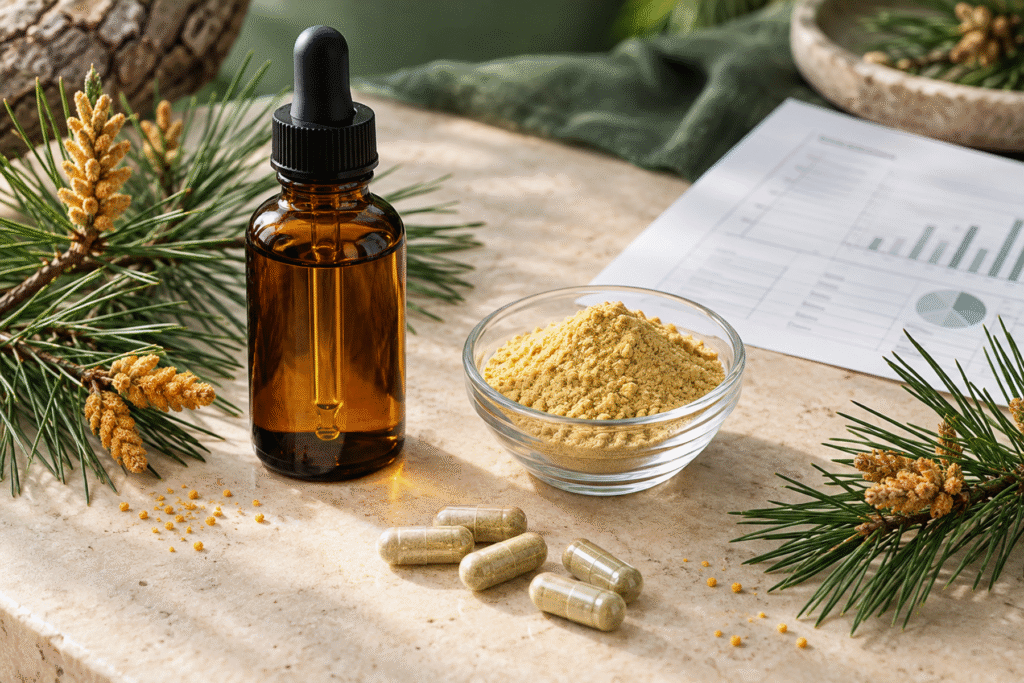
One product says Pinus massoniana. Another simply says “wild pine pollen.” One is cracked-cell powder, another is a tincture, and a third promises “maximum bioavailability” without explaining what that means.
Then come the badges.
Lab tested. Premium grade. Full spectrum. Wild harvested. High potency. Pharmaceutical quality.
One of the easiest ways to compare pine pollen products is to ignore the front of the package for a moment and work backward from a simpler question:
What exactly is this product, and can the company demonstrate that it is what it claims to be?
Once you answer that, most of the marketing becomes much easier to judge.
Key Takeaways
- A complete botanical name gives you more information than the generic phrase “pine pollen,” but species identification alone does not prove quality.
- Powder and tincture are different preparations and should not be compared using vague potency language alone.
- “Lab tested” is meaningful only when you know what was tested, which methods and limits were used, and whether the results apply to the relevant lot.
- A useful Certificate of Analysis should connect to the product or batch and report actual results, units, specifications, methods, and dates.
- Transparent sourcing, realistic evidence claims, and relevant contaminant testing matter more than premium-looking badges.
Table of Contents
- Start With the Botanical Name
- Make Sure the Plant Part Is Actually Pollen
- Ask Where It Came From
- Wild-Harvested Is a Description, Not a Quality Grade
- Powder and Tincture Are Different Products
- Understand Cracked-Cell Processing
- Read Tincture Labels and Extraction Ratios Carefully
- Confirm Authenticity
- Understand What Lab Tested Means
- Check the COA and Lot Number
- Interpret Certifications and Marketing Claims
- Compare Price Only After Quality
- Use the Product Comparison Scorecard
- Frequently Asked Questions
- References and Further Reading
Start With the Botanical Name
The first thing I look for is the species.
“Pine pollen” describes pollen from trees in the genus Pinus. It does not identify one particular pine.
Commercial products may use pollen from species such as:
- Pinus massoniana — Masson pine
- Pinus tabuliformis — Chinese pine or Chinese red pine
- Other species within the genus Pinus
If one product clearly identifies Pinus massoniana while another simply says “pine pollen,” the first product is giving you more useful botanical information.
That does not automatically make it better.
But transparency is a good starting point.
The species becomes especially important when a seller makes claims about traditional use, research, geographic origin, or chemical composition. Research performed on one Pinus species should not automatically be presented as though it applies identically to every other pine.
Make Sure the Plant Part Is Actually Pollen
Pine trees provide several botanically distinct materials.
These include:
- Pollen
- Bark
- Needles
- Resin
- Seeds
- Wood
They do not have the same composition.
A product marketed as pine pollen should clearly identify pollen as the botanical material being used.
This sounds obvious, but clear plant-part identification is one of the basic signs that a botanical company understands its raw material.
Ask Where It Came From
Once the species is clear, look at origin.
For Pinus massoniana, sourcing from China makes botanical sense because Masson pine is native and widely distributed across central and southern China.
But “Product of China” and “sourced from a known growing region in southern China” provide different amounts of information.
Ideally, a company should know at least the general geographic source of its pollen.
That matters because growing environment can affect:
- Soil exposure
- Agricultural activity
- Potential pesticide exposure
- Atmospheric pollution
- Climate
- Harvest timing
- Storage conditions
Geography does not determine quality by itself.
It gives you traceability.
“Wild-Harvested” Is a Description, Not a Quality Grade
Wild harvesting can sound appealing.
It creates an image of collectors walking through untouched mountain forests gathering pollen from old pine trees.
Sometimes that image may be reasonably accurate.
But the phrase alone tells you almost nothing about quality.
Wild-harvested material can still be exposed to:
- Environmental contamination
- Nearby agricultural chemicals
- Incorrect species identification
- Poor handling
- Excessive moisture
- Dirty drying conditions
- Improper storage
Likewise, pollen harvested from a managed forest is not automatically inferior.
A controlled source may actually provide better traceability.
So when two products compete on “wild-harvested” versus “forest-grown,” I would not choose based on that phrase alone.
Ask what happens after the pollen leaves the tree.
Powder and Tincture Are Different Products
One of the biggest mistakes when comparing pine pollen is treating powder and tincture as though they differ only in convenience.
They do not.
Pine pollen powder contains the physical pollen material.
A tincture contains compounds extracted from pollen into a liquid solvent, commonly ethanol and water.
That means an honest comparison starts by deciding which type of preparation you actually want.
Powder may make more sense if you want:
- The whole pollen material
- A product without extraction alcohol
- A food-like botanical powder
- The option to mix it into food or drinks
Tincture may make more sense if you want:
- A small liquid serving
- A hydroalcoholic botanical extract
- No powder texture
- A preparation focused on solvent-extractable compounds
Neither format is automatically superior.
They are different preparations.
Comparing a tincture with a powder using only the word “potency” usually creates more confusion than clarity.
If It Is Powder, Ask Whether It Is Cracked-Cell
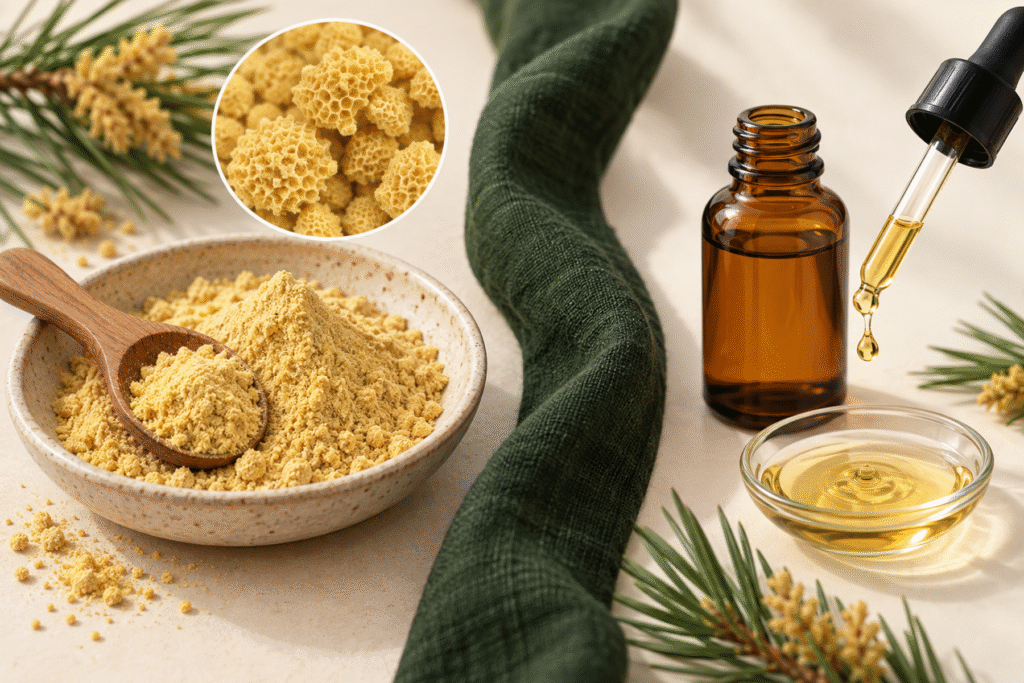
Pine pollen grains have a durable outer structure.
That is useful for a pollen grain traveling through the environment, but it has led manufacturers to mechanically process pollen in an attempt to disrupt that structure.
Products may therefore be described as:
- Whole pollen
- Cracked-cell pollen
- Broken-cell-wall pollen
- Cell-wall-broken pollen
Processing can affect pine pollen’s physical and chemical characteristics, and research reviews specifically note that post-harvest processing influences composition.
But do not let “cracked cell” become a shortcut for “better.”
A company should ideally be able to explain:
- How the pollen is processed
- Whether the process uses excessive heat
- At what stage botanical identity is verified
- How the material is protected after processing
“99% cracked” sounds precise.
Without a documented method behind the number, it may tell you less than you think.
If It Is a Tincture, Read the Back Label Carefully
For tinctures, I would immediately look for the extraction details.
A useful label should identify:
- Botanical species
- Pollen as the plant material
- Extraction solvent
- Alcohol content
- Serving volume
- Other ingredients
- Extraction ratio, when meaningfully stated
- Suppose Product A says:
Pine pollen extract, organic cane alcohol, purified water
while Product B identifies:
Pinus massoniana* pollen extract — 1:2 — 45% ethano
Product B gives you considerably more information about how the product was made.
Again, transparency does not automatically prove superior performance.
But it makes comparison possible.
Do Not Rank Tinctures by Alcohol Percentage Alone
A 70% alcohol tincture is not automatically stronger than a 40% tincture.
Alcohol and water extract different groups of compounds.
Changing the ratio between them changes the solvent system and therefore changes what is recovered from the pollen.
Higher alcohol may favor some less-polar constituents.
More water may improve extraction of certain water-soluble constituents.
There is no universally proven alcohol percentage that makes every desirable component of pine pollen extract better.
So if a company advertises “extra high alcohol extraction” as though the number itself proves potency, I would want more explanation
Extraction Ratios Need Context Too
You may see tinctures labeled:
1:1
1:2
1:5
These ratios generally describe the relationship between the starting botanical material and extraction liquid, depending on the manufacturer’s convention.
When the same weight-to-volume convention and type of starting material are used, a 1:2 extract generally represents more starting botanical material per unit of solvent than a 1:5 extract. However, ratios cannot be compared reliably unless the manufacturer explains its convention and whether the pollen was measured in fresh, dried, or processed form.
Even then, the ratio does not prove that more of every desirable compound made it into the bottle.
Extraction also depends on:
- Solvent composition
- Particle size
- Cell-wall processing
- Time
- Temperature
- Agitation
- Filtration
- Starting-material quality
A ratio is useful information.
It is not a complete potency measurement.
Then Ask the Question That Marketing Often Skips: Is It Authentic?
Before comparing “strength,” make sure you are comparing actual pine pollen.
Published authenticity research has identified cattail pollen and corn flour as potential adulterants in commercial pine pollen products.
Botanical identity can be investigated using methods such as microscopy and, where appropriate, molecular techniques.
That becomes particularly important once pollen has been heavily processed.
An intact pollen grain has recognizable microscopic features.
Once it is finely milled, blended, placed in a tablet, or extracted into liquid, much of that visual evidence may disappear.
A trustworthy supply chain therefore establishes identity at the appropriate point before processing makes authentication harder.
“Lab Tested” Is Where the Real Comparison Begins
Now we get to one of the most useful differences between products.
Almost anyone can print “LAB TESTED” on marketing material.
The useful question is:
Tested for what?
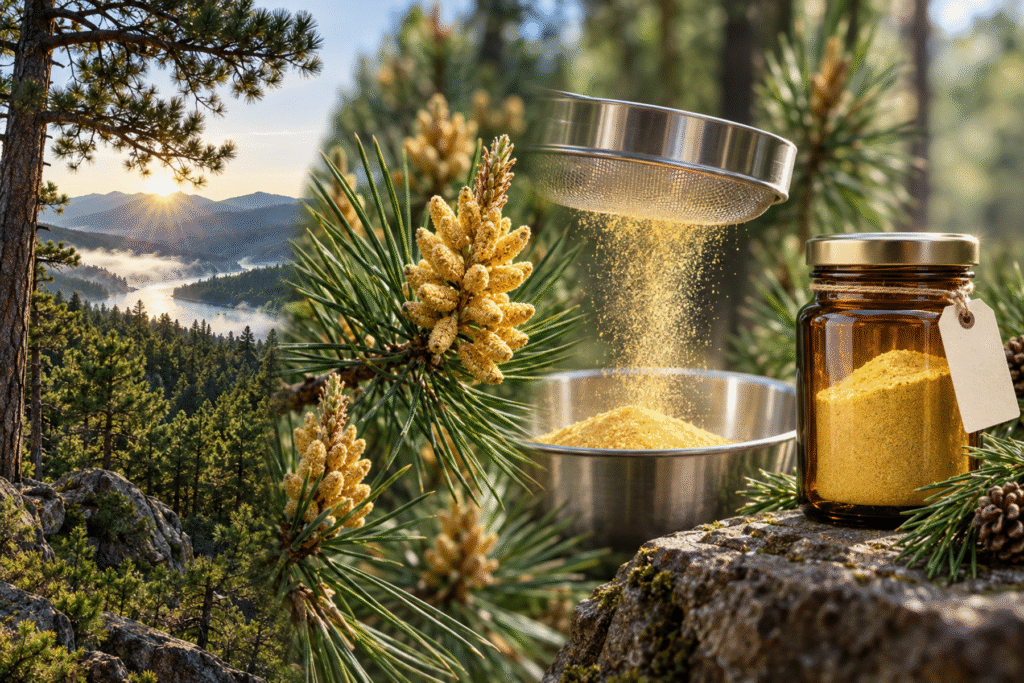
For pine pollen, I would want a quality program that considers several separate categories.
Botanical identity
Does the ingredient actually match the species claimed?
Heavy metals
Commonly evaluated elements include:
- Lead
- Cadmium
- Arsenic
- Mercury
Microbiological quality
Depending on the preparation and specification, testing may include:
- Total aerobic microbial count
- Yeast and mold
- Escherichia coli
- Salmonella
Pesticide residues
A broad multiresidue panel can be much more informative than a vague claim that the product has been “pesticide tested.”
Mycotoxins
Testing for compounds such as aflatoxins may be appropriate when sourcing and storage conditions create fungal risk.
Those tests answer different questions.
Passing a heavy-metal panel does not prove the product is free from harmful microorganisms.
FDA’s dietary-supplement current good manufacturing practice framework addresses identity, purity, strength, composition, and contamination as distinct aspects of product quality.
Ask to See the COA—Then Check the Lot
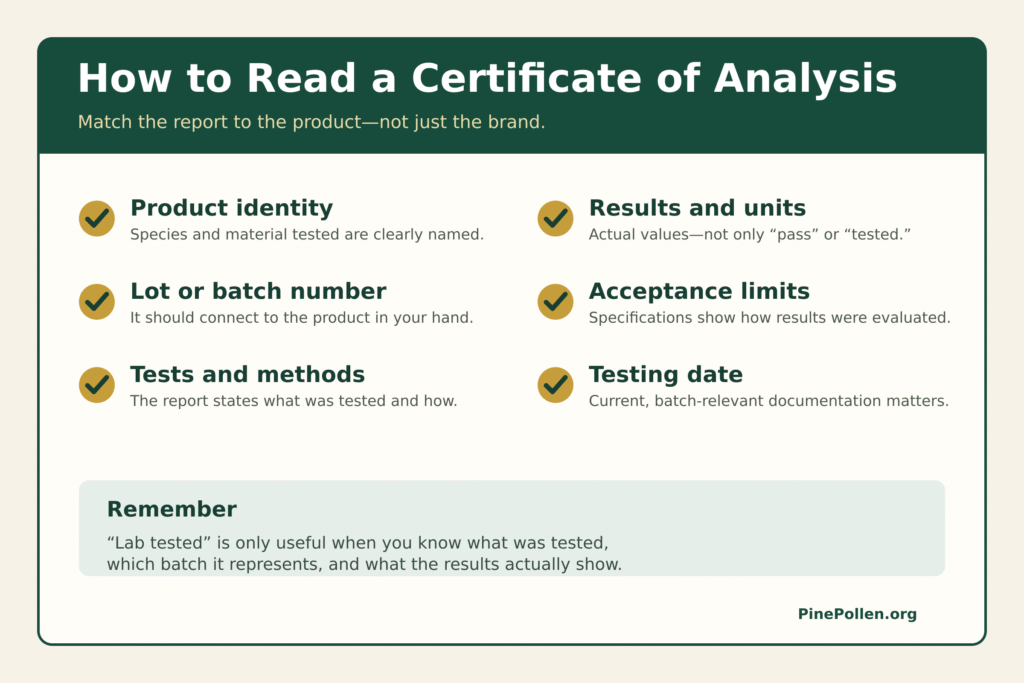
A Certificate of Analysis, or COA, can be useful.
But not all COAs are equally informative.
The first thing you should check is the lot number.
If your bottle is Lot PP-0826, ideally the documentation should connect to that lot or clearly trace back through the manufacturing records to the relevant tested material.
Then look for:
- Test performed
- Result
- Units
- Specification or acceptance limit
- Test method
- Date
- Lot or batch identifier
A beautiful laboratory report from several years ago does not necessarily tell you anything about the current production batch.
Batch relevance matters.
Third-Party Testing Is Useful—But Do Not Stop There
Independent laboratory testing can be valuable.
It separates at least part of the analytical process from the company selling the product.
But “third-party tested” alone still leaves questions.
Did the laboratory test:
- One batch or every batch?
- Heavy metals only?
- Identity?
- Pesticides?
- Microbiology?
- The raw pollen or finished product?
A third-party laboratory can only report on the tests it was asked to perform.
So compare testing scope, not simply the presence of a laboratory logo.
Organic, Non-GMO, and GMP Badges Answer Different Questions
Certification badges can be useful, but they are often misunderstood.
Organic generally relates to how an agricultural ingredient was produced under an applicable certification system.
It does not prove the absence of every heavy metal or microorganism.
Non-GMO tells you something different again.
And GMP relates to manufacturing practices, not whether a particular bottle has been individually approved by FDA.
FDA requires dietary-supplement manufacturers subject to its CGMP rules to follow manufacturing controls intended to help ensure products contain what they claim and are not contaminated with harmful or undesirable substances.
FDA does not approve dietary supplements for safety and effectiveness, or approve their labeling, before they are marketed. Manufacturers and distributors remain responsible for product safety, compliant manufacturing, and truthful labeling.
So “FDA approved pine pollen” would be a warning sign rather than a selling point.
Be Skeptical of Potency Claims That Cannot Be Measured
Some products rely heavily on words such as:
- Maximum strength
- Ultra potent
- Pharmaceutical grade
- Superior bioavailability
- Hormone activating
- Testosterone boosting
- Full spectrum
- Super concentrated
- Ask yourself a simple question:
What measurable specification supports that statement?
If “maximum strength” means a documented botanical-to-solvent ratio, that can be evaluated.
If “high potency” means the finished extract contains a standardized concentration of a specified chemical marker, that can potentially be measured.
But if the explanation is simply that the product “feels stronger,” the claim tells you very little.
Your Quick Pine Pollen Comparison Scorecard
When comparing products side by side, I would score them in roughly this order:
1. Botanical identity
Does it clearly identify the species, preferably something specific such as Pinus massoniana?
2. Traceable origin
Can you determine where the pollen comes from?
3. Clear preparation
Is it whole powder, cracked-cell powder, or tincture?
4. Processing transparency
Does the company explain how it processes or extracts the pollen?
5. Meaningful testing
Are identity and relevant contaminants actually evaluated?
6. Batch documentation
Is there a lot-specific or appropriately traceable COA?
7. Ingredient simplicity
Are unnecessary fillers or poorly explained additives present?
8. Evidence-based claims
Does the company distinguish promising research from established human evidence?
9. Useful labeling
Can you determine serving size, alcohol content, extraction ratio, and other key specifications?
10. Price
Only compare cost after the first nine points.
That order is deliberate.
A cheap mystery powder is still a mystery powder.
Green Flags Worth Noticing
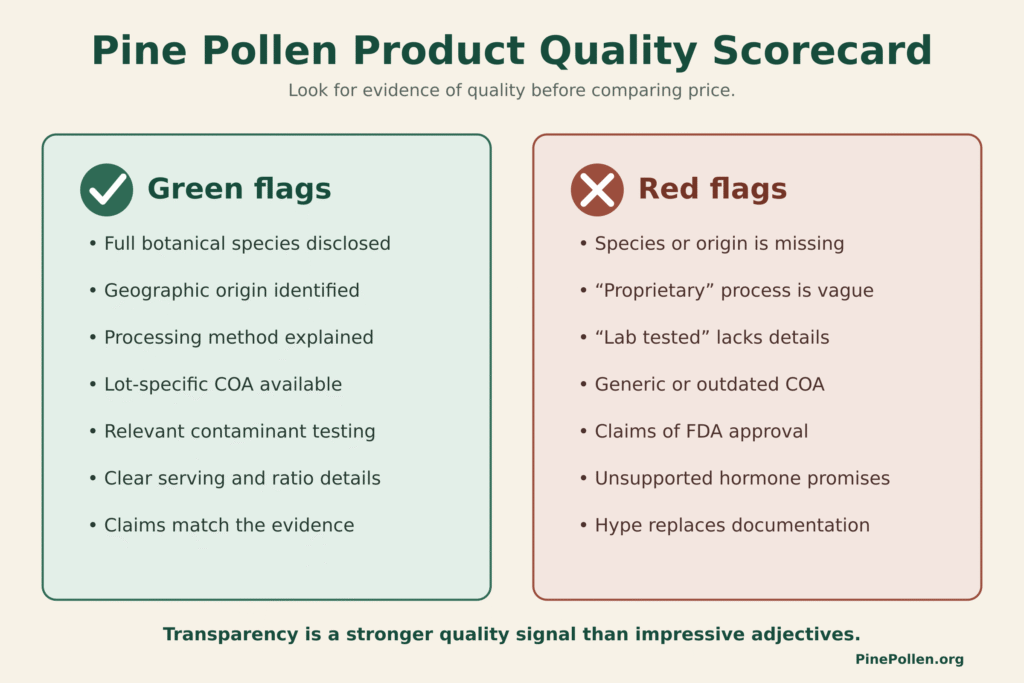
A product earns my attention when the company makes important information easy to find.
Strong signs include:
- Full botanical species disclosed
- Pollen clearly identified as the plant material
- Geographic sourcing information
- Clear explanation of whole versus cracked-cell pollen
- Extraction details for tinctures
- Alcohol percentage disclosed
- Lot identification
- Meaningful contaminant testing
- COA availability
- Realistic descriptions of the research
- Clear allergen and safety information
None of these guarantees a perfect product.
Together, they suggest a much more serious approach to botanical quality.
Red Flags Worth Slowing Down For
You should become more cautious when you see:
- No species identification
- No sourcing information
- “Proprietary processing” used to avoid explaining basic manufacturing
- “Lab tested” without saying what was tested
- Generic COAs unrelated to current lots
- Claims of FDA approval
- Dramatic testosterone promises
- Claims that cracked-cell pollen is automatically many times more effective
- Claims that tincture is universally superior to powder
- Huge emphasis on “wild-harvested” with little quality documentation
- A long list of badges but very little actual data
Good products do not need to hide behind mystery.
The Best Product Is Usually the One You Can Understand
After comparing enough botanical supplements, a pattern becomes obvious.
The most convincing product is rarely the one using the most impressive adjectives.
It is the one that answers ordinary questions clearly.
What pine species is this?
Where did it come from?
Is it pollen?
How was it processed?
What is in the bottle?
What was tested?
Can I see the results?
What does the research actually support?
Those questions are not particularly glamorous.
They are extremely effective.
When two pine pollen products are sitting side by side, I would choose transparency over hype almost every time.
Because whether you are comparing Pinus massoniana powder, cracked-cell pollen, or an alcohol tincture, quality starts with knowing what you are buying.
Everything else comes after that.
Frequently Asked Questions:
What is the first thing to check on a pine pollen label?
Start with the botanical name and plant part. A useful label should identify the material as pine pollen and, ideally, disclose the Pinus species. That information does not prove quality, but it establishes what the company claims the ingredient to be.
Is cracked-cell pine pollen automatically better than whole pollen?
No. Cracked-cell processing changes the physical structure of the pollen, but the phrase alone does not prove superior effectiveness. Ask how the material was processed, how the claimed cracking percentage was measured, and how identity and quality were protected after processing.
Does a higher alcohol percentage make a tincture stronger?
Not necessarily. Alcohol and water extract different groups of compounds. The alcohol percentage describes part of the solvent system; it is not, by itself, a measurement of clinical potency or overall product quality.
What should a useful Certificate of Analysis contain?
A useful COA should identify the tested material or finished product, include a lot or batch reference, name the tests performed, report results and units, show specifications or acceptance limits, identify methods where appropriate, and include the testing date.
Does third-party tested mean every batch was comprehensively tested?
No. It means an outside laboratory performed at least one requested analysis. You still need to know which batch and material were tested and whether the scope included identity, heavy metals, microorganisms, pesticides, mycotoxins, or other relevant specifications.
Does an organic or GMP badge prove that a product is contaminant-free?
No. Organic certification and good manufacturing practices address different parts of production and manufacturing. Neither badge replaces relevant, batch-connected analytical testing.
Are dietary supplements approved by FDA before sale?
No. FDA does not approve dietary supplements for safety and effectiveness before they are marketed. Companies are responsible for meeting applicable safety, manufacturing, and labeling requirements, while FDA generally oversees the market through inspections, monitoring, and enforcement.
What is the biggest warning sign when comparing pine pollen products?
Be cautious when dramatic claims are paired with little verifiable information. Missing species identification, unclear sourcing, unexplained “lab tested” language, generic COAs, and claims of FDA approval are stronger warning signs than an ordinary-looking package.
References and Further Reading
- Cheng Y, et al. “Pine pollen: A review of its chemical composition, health effects, processing, and food applications.” Trends in Food Science & Technology. 2023;138:599–614. View the DOI record.
- Wang R, et al. “Botanical Origin Authenticity Control of Pine Pollen Food Products Using Multiplex Species-Specific PCR Method.” Food Analytical Methods. 2022;15:421–427. View the DOI record.
- U.S. Food and Drug Administration. “Questions and Answers on Dietary Supplements.” View FDA guidance.
- Electronic Code of Federal Regulations. “21 CFR Part 111—Current Good Manufacturing Practice in Manufacturing, Packaging, Labeling, or Holding Operations for Dietary Supplements.” View the regulation.
- U.S. Food and Drug Administration. “FDA 101: Dietary Supplements.” View the FDA consumer overview.
Editorial and Medical Disclaimer
This article is provided for educational and informational purposes only. It is not medical advice and is not intended to diagnose, treat, cure, or prevent any disease. Pine pollen products may not be appropriate for everyone. Consult a qualified healthcare professional before using a dietary supplement, particularly if you have allergies, are pregnant or breastfeeding, take medication, or have a medical condition.
PinePollen.org | Educational Article