To researchers, however, pine pollen has become something else as well—a compact package of proteins, lipids, carbohydrates, sterols, phenolic compounds, and other plant chemicals worth studying.
That scientific interest has produced a surprisingly broad literature, especially around pollen from Pinus massoniana (Masson pine) and Pinus tabuliformis (Chinese pine).
The catch is that not all pine pollen research is equal.
Some studies simply identify what is present in the pollen. Others use isolated compounds in test tubes. Some involve mice. Only a small portion examines people directly.
That distinction matters enormously.
A useful way to understand pine pollen science is therefore not to ask, “Does pine pollen work?”
Ask instead:
What was studied, how was it studied, and how close is that evidence to demonstrating an effect in humans?
That is what this evidence map is designed to answer.
Key Takeaways
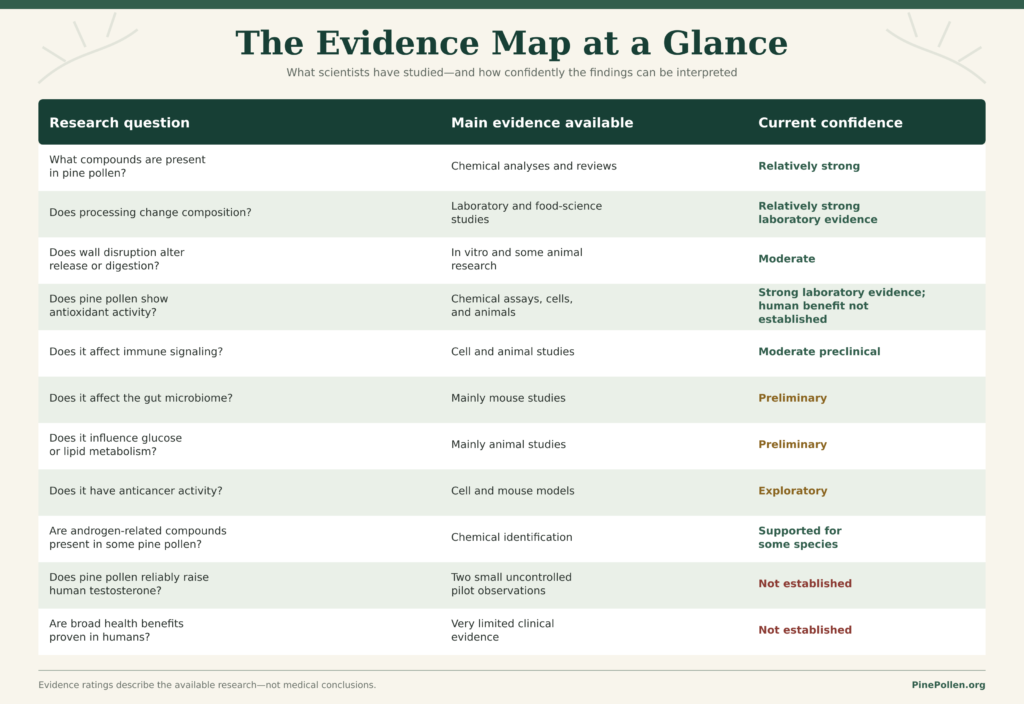
- The strongest pine pollen evidence concerns its chemical composition and how processing changes the material.
- Much of the research uses isolated compounds, cultured cells, or animals rather than ordinary commercial products tested in people.
- Results from purified polysaccharides cannot automatically be applied to whole pollen powder or tincture.
- Laboratory antioxidant, immune, metabolic, and anticancer findings do not establish corresponding health benefits in humans.
- Androgen-related compounds have been identified in some pine species, but reliable testosterone effects in humans have not been established.
- Human research remains limited to very small, uncontrolled pilot observations that require independent confirmation.
Table of Contents
- Before the Health Claims, Ask What Researchers Actually Used
- The Strongest Part of the Map: What Pine Pollen Contains
- Processing Research Is Becoming Increasingly Important
- Polysaccharides Are the Workhorses of Pine Pollen Research
- Antioxidant Findings: Real, but Easy to Oversell
- Immune Research: Plenty of Signals, Mostly Before the Human Stage
- The Gut and Microbiome May Be One of the More Interesting Directions
- Metabolic Research Is Mostly Hypothesis-Generating
- Anticancer Research Sounds Dramatic—Because the Experimental Models Are Dramatic
- The Testosterone Story Has the Largest Gap Between Interest and Certainty
- Human Testosterone Studies: Interesting, but Still Pilot Evidence
- The Evidence Map at a Glance
- Why Pine Pollen Studies Are So Easy to Misread
- What Would Better Pine Pollen Research Look Like?
- The Most Honest Reading of the Science
- Frequently Asked Questions
- References and Further Reading
Before the Health Claims, Ask What Researchers Actually Used
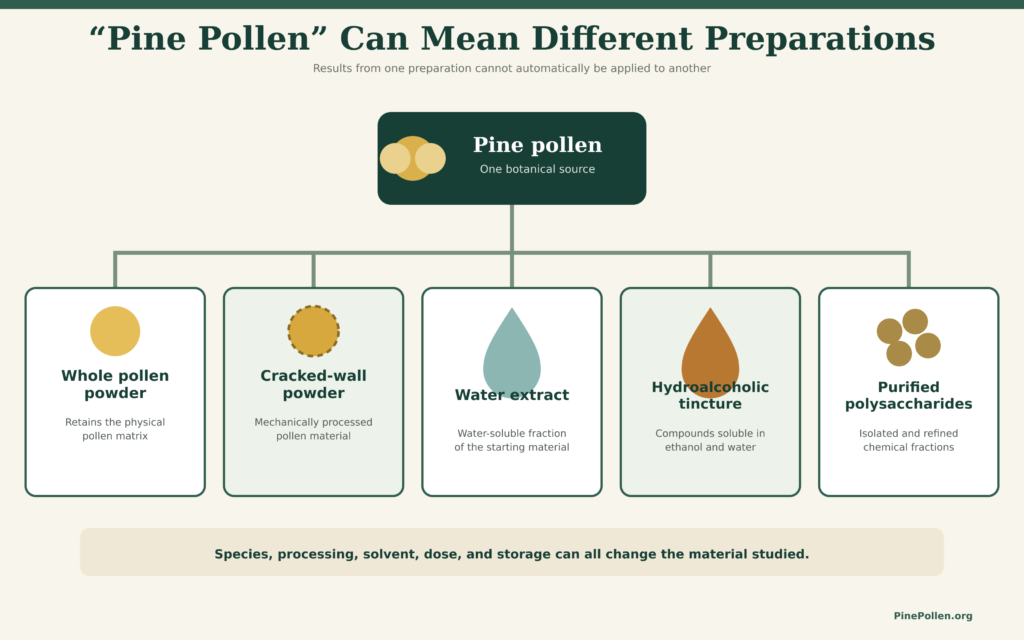
One of the easiest mistakes in botanical research is treating every preparation from the same plant as though it were identical.
Pine pollen studies may examine:
- Whole pollen powder
- Broken- or cracked-wall pollen
- Water extracts
- Alcohol extracts
- Hydroalcoholic extracts
- Purified polysaccharides
- Phenolic-rich fractions
- Individual isolated compounds
Scientists call this fractionation (separating a complex natural material into smaller chemical groups).
That distinction is not academic nitpicking.
A purified polysaccharide extracted from Pinus massoniana pollen is chemically very different from a commercial pine pollen tincture.
Likewise, an effect produced by a concentrated laboratory fraction cannot automatically be assigned to a teaspoon of whole pollen powder.
A 2023 review of pine pollen research makes this point indirectly throughout: species, geography, and especially post-harvest processing can substantially change chemical composition and biological properties.
Before interpreting any result, the preparation matters.
The Strongest Part of the Map: What Pine Pollen Contains
The most established pine pollen science concerns composition.
Researchers have repeatedly identified a mixture of:
- Proteins and amino acids
- Carbohydrates
- Polysaccharides
- Lipids and fatty acids
- Minerals
- Phenolic compounds
- Flavonoids
- Phytosterols
- Vitamins and other minor constituents
These are phytochemicals (naturally occurring chemicals produced by plants) alongside ordinary nutrients.
The exact profile is not fixed.
Pollen from one Pinus species may differ from another. Climate, altitude, soil, maturity, drying, wall-breaking, sterilization, and storage can all affect what laboratory analysis finds.
So the statement “pine pollen contains biologically interesting compounds” is well supported.
The statement “therefore pine pollen produces a particular health benefit in people” is a much larger leap.
Composition tells us what could be worth studying.
It does not prove what happens after someone consumes it.
Processing Research Is Becoming Increasingly Important
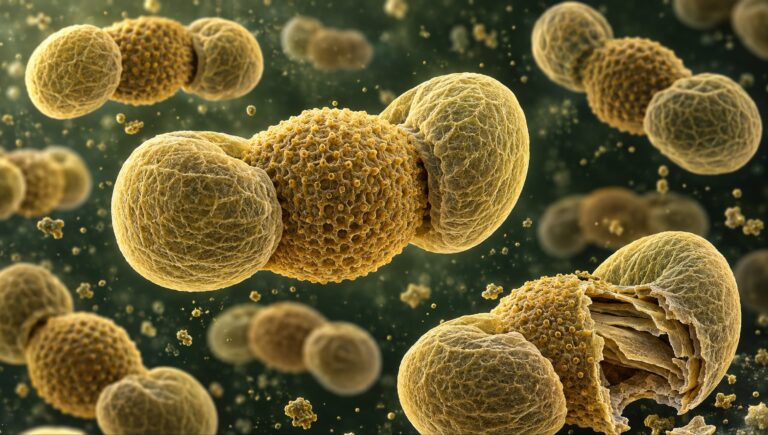
Pine pollen is unusual because its outer wall is extremely durable.
That wall contains sporopollenin (a highly resistant natural polymer that helps pollen survive drying, sunlight, and environmental exposure).
Researchers have studied what happens when that structure is broken using milling, ultrasound, heat, irradiation, and other processing methods.
These studies show that wall disruption can alter the release of nutrients and phytochemicals during extraction and simulated digestion.
But processing is not automatically beneficial in every respect.
High temperatures, for example, can accelerate oxidation or degrade sensitive compounds, while other treatments may improve accessibility without creating the same degree of heat damage.
The broader review literature therefore treats processing as a major determinant of pine pollen chemistry—not simply a yes-or-no question about whether the pollen wall is “cracked.”
Evidence level: reasonably strong for demonstrating physical and chemical changes.
What remains uncertain: whether a particular processing method produces meaningfully better health outcomes in humans.
Polysaccharides Are the Workhorses of Pine Pollen Research
If there is one chemical group that dominates pine pollen biology research, it is polysaccharides.
Polysaccharides are large carbohydrate molecules built from many smaller sugar units linked together.
Researchers have extracted and purified them from Pinus massoniana, Pinus tabuliformis, and related species, then examined their structure and biological behavior.
A 2024 review catalogued reported antioxidant, immune-modulating, anti-inflammatory, metabolic, antiviral, antibacterial, liver-related, and antitumor activities associated with pine pollen polysaccharides. But the same review emphasized major gaps in safety data, structural characterization, and understanding of structure–activity relationships—the connection between a molecule’s architecture and what it does biologically.
That is an important balance.
There is plenty to investigate.
There is much less certainty about how these purified fractions translate into everyday supplementation.
Antioxidant Findings: Real, but Easy to Oversell
Pine pollen extracts and isolated fractions frequently perform well in antioxidant experiments.
An antioxidant assay is a laboratory test that measures how effectively a substance neutralizes or interacts with reactive chemical species.
These experiments are useful.
They help identify compounds that may influence oxidative stress (an imbalance between reactive molecules and the biological systems that control them).
But antioxidant research has several levels:
- A chemical reaction in a test tube
- An effect in cultured cells
- An effect in an animal model
- A meaningful health outcome in a person
Those are not interchangeable.
A pollen fraction that neutralizes free radicals in a laboratory assay has demonstrated antioxidant chemistry.
It has not demonstrated that taking the product prevents aging, cardiovascular disease, or another human condition.
This is one of the clearest places where supplement marketing can outrun the evidence.
Immune Research: Plenty of Signals, Mostly Before the Human Stage
Pine pollen polysaccharides have also been studied for effects on immune cells.
Researchers have reported changes involving macrophages, antibody responses, intestinal immune tissues, and cytokines (small signaling proteins that immune cells use to communicate).
This is often summarized online as “pine pollen boosts immunity.”
That wording is too crude.
A better scientific term is immunomodulation—changing or regulating immune activity.
An immune-modulating substance might increase one response, reduce another, or alter communication between different immune-cell populations.
Much of the pine pollen literature in this area uses animals or purified polysaccharides rather than ordinary commercial pollen products. The 2024 polysaccharide review describes immune-related activity as a prominent research area while also emphasizing the need for better mechanistic and safety studies.
Evidence level: substantial preclinical research.
What it does not prove: that pine pollen supplements generally “strengthen” human immunity.
The Gut and Microbiome May Be One of the More Interesting Directions
Some of the newer research focuses on the intestine.
In a 2021 Food & Function study, researchers gave purified Pinus massoniana pollen polysaccharides to mice and observed changes in gut microbial composition. They also reported effects on intestinal immune tissues and improvements in experimental models of intestinal injury and chemically induced colitis.
The microbiome is the community of microorganisms living in an environment such as the gut.
Large plant polysaccharides are especially interesting here because they do not necessarily need to enter the bloodstream intact to have biological effects.
Gut microbes may ferment them and produce smaller metabolites, including short-chain fatty acids, that can interact with the intestinal environment.
That creates a plausible research pathway.
But again, this particular study involved mice, cell models, and a purified pollen polysaccharide preparation—not a trial in people drinking a pine pollen tincture.
Evidence level: promising mechanistic and animal research.
Human relevance: still uncertain.
Metabolic Research Is Mostly Hypothesis-Generating
Studies and reviews also report effects involving glucose regulation, lipid metabolism, cholesterol, and experimental diabetes models.
These findings deserve attention, but context is essential.
Researchers can induce metabolic disturbances in laboratory animals and then test whether a botanical fraction changes blood glucose, lipids, inflammatory markers, or tissue damage.
That tells us whether a biological mechanism is worth pursuing.
It does not show that pine pollen treats diabetes, high cholesterol, or metabolic syndrome in people.
Clinical treatment claims require controlled human trials.
At present, the metabolic portion of the evidence map remains largely preclinical.
Anticancer Research Sounds Dramatic—Because the Experimental Models Are Dramatic
Pine pollen polysaccharides have even entered cancer research.
A 2022 study published in Food & Function tested polysaccharides extracted from Pinus massoniana pollen against colorectal cancer cells and in mice carrying human colorectal tumor xenografts.
The researchers reported reduced cancer-cell proliferation, changes in the cell cycle, increased apoptosis (a controlled process through which cells self-destruct), and reduced tumor growth in the mouse model.
That is biologically interesting.
It is also very early-stage evidence.
Cancer cells growing in culture are exposed directly to experimental concentrations of the test material.
A person swallowing pine pollen faces an entirely different sequence: digestion, absorption, metabolism, distribution, and elimination.
The study does not establish pine pollen as a cancer treatment.
It establishes a reason for further research into particular polysaccharides.
Those are very different conclusions.
The Testosterone Story Has the Largest Gap Between Interest and Certainty
No pine pollen claim attracts more attention than testosterone.
The story begins with a genuine chemical observation.
In 1971, researchers reported testosterone, epitestosterone, and androstenedione in pollen from Pinus sylvestris (Scots pine). Later scientific literature has continued to cite those findings as evidence that steroid compounds generally associated with animals can occur naturally in plants.
That gives us one answer:
Can androgen-related compounds occur in pine pollen?
Yes, at least in some species.
It does not answer several much harder questions:
Are those compounds consistently present in Pinus massoniana*?
- At what concentrations?
- Does a particular tincture extract them efficiently?
- Are they absorbed in meaningful amounts?
- Do they alter hormone levels in people?
Those require different experiments.
Human Testosterone Studies: Interesting, but Still Pilot Evidence
The human evidence map has changed slightly in recent years.
A 2024 open-label pilot followed 10 men aged 47–78 who used a proprietary Pinus massoniana tincture for eight weeks. Mean total testosterone rose from 362.5 to 448.4 ng/dL, but the testosterone change narrowly missed conventional statistical significance at P = 0.0584. Self-reported qADAM symptom scores improved significantly. The study had no placebo group or blinding, and the product manufacturer provided the tincture and study support.
A second open-label pilot was reported by the product manufacturer in 2025. It involved younger men aged 25–50, with 11 participants completing the eight-week trial. According to the manufacturer’s report, mean total testosterone did not change significantly, while mean sex hormone-binding globulin fell and calculated free testosterone increased. Symptom and quality-of-life scores were also reported to have improved. Again, there was no placebo control or blinding, and the report should not be treated as equivalent to an independently published clinical trial.
These observations are worth knowing about.
They are best understood as pilot observations.
Small uncontrolled studies are useful for generating hypotheses and estimating what future trials should measure.
They cannot tell us whether the changes were caused by the tincture rather than natural hormone variation, regression toward the mean, expectation effects, lifestyle factors, or other influences.
The next meaningful step would be a larger randomized, placebo-controlled trial.
Why Pine Pollen Studies Are So Easy to Misread
Four recurring problems make this literature difficult to compare.
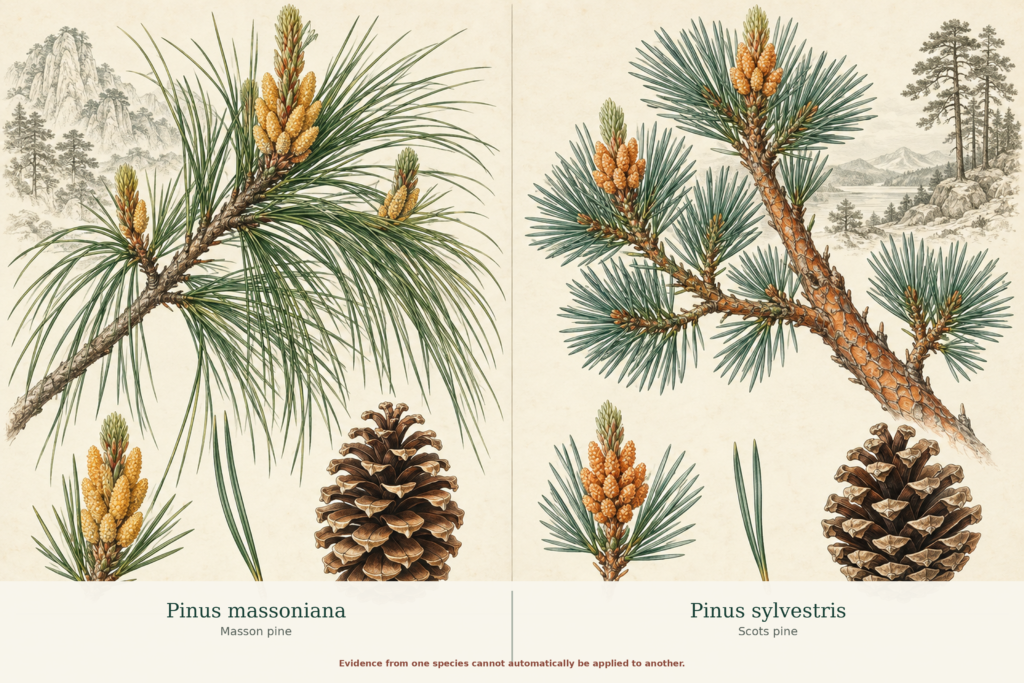
Species mismatch
Pinus massoniana is not Pinus sylvestris.
A finding in Scots pine pollen should not automatically be assigned to Masson pine.
Preparation mismatch
Purified polysaccharides are not whole pollen.
Whole pollen is not an alcohol tincture.
A broken-wall powder is not chemically identical to a water extract.
Dose mismatch
Experimental animals may receive carefully measured doses of purified material that bear little resemblance to ordinary consumer servings.
Outcome mismatch
A change in a biomarker is not necessarily the same as improved health.
Scientists distinguish surrogate markers—measurements associated with a biological process—from outcomes such as improved symptoms, lower disease rates, or longer survival.
That distinction prevents interesting laboratory results from becoming premature clinical claims.
What Would Better Pine Pollen Research Look Like?
The field does not primarily need more lists of compounds.
It needs translation.
Future research would become much more useful if scientists focused on:
Chemically characterized Pinus massoniana* products
- Head-to-head comparisons of whole pollen, broken-wall powder, and tincture Pharmacokinetic studies (research tracking absorption, metabolism, distribution, and elimination*)
- Dose-response studies
- Controlled human safety trials
- Randomized placebo-controlled hormone studies
- Human microbiome research
- Better analytical markers for batch consistency
- Independent replication by research groups not connected to product manufacturers
- Clear reporting of species, geography, processing, solvent, and dose
That last point may sound mundane.
It is not.
Botanical research becomes much more useful when another scientist can identify exactly what material was tested and reproduce the experiment.
The Most Honest Reading of the Science
Pine pollen is not scientifically empty.
Quite the opposite.
Researchers have identified a rich chemical profile, learned a great deal about how processing changes the material, and found biological activity in purified fractions across immune, intestinal, metabolic, antioxidant, and cancer-related experimental systems. Recent human pilot studies have even begun probing hormone-related questions.
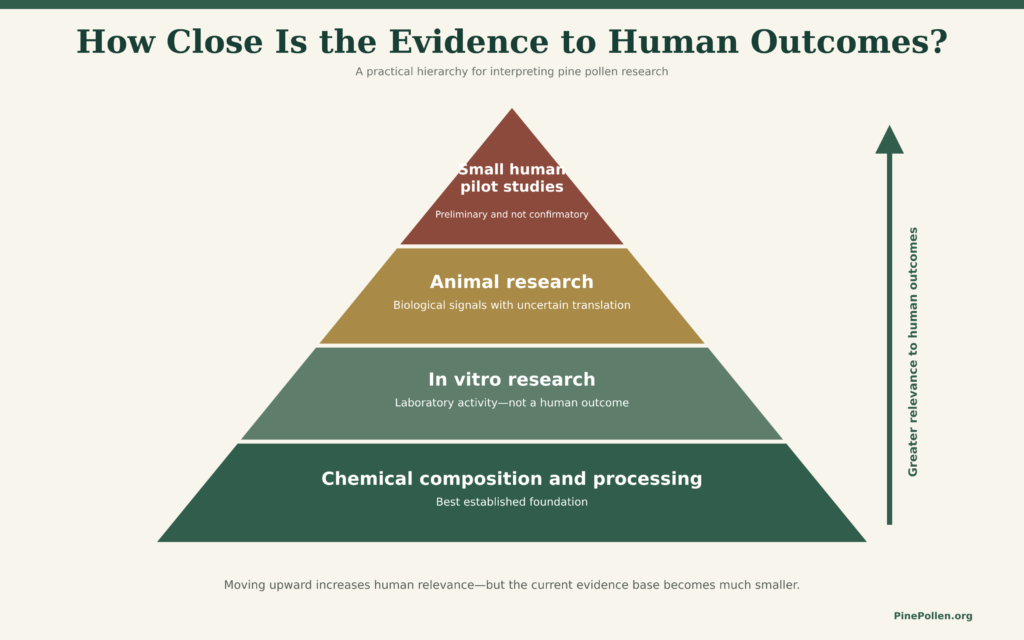
But the evidence has a shape.
The broad base consists of chemistry and laboratory science.
Above that sits a substantial body of animal research.
At the narrow top are human trials—and that portion remains small.
For wellness consumers, that evidence map is more useful than either extreme.
There is no reason to dismiss pine pollen simply because the human literature is incomplete.
There is also no scientific basis for treating every promising cell or mouse study as a proven human benefit.
The most interesting question now is not whether scientists can find biological activity in pine pollen.
They clearly can.
The harder question—and the one that will determine its real value—is which of those laboratory signals survive the journey into the human body.
Frequently Asked Questions:
Is pine pollen scientifically proven to provide health benefits?
Pine pollen has been studied extensively enough to establish that it contains nutrients and phytochemicals and that extracts or purified fractions can show biological activity in laboratory and animal models. That is not the same as proving broad health benefits in people. Controlled human trials remain very limited, so most condition-specific claims should be described as preliminary or unestablished.
What type of pine pollen research is strongest?
The strongest evidence concerns chemical composition and processing. Researchers can identify compounds in pollen and measure how drying, wall disruption, extraction, or storage changes the material. Evidence becomes less certain when moving from laboratory measurements to animal effects and weaker still when asking whether a commercial pine pollen product improves human health.
Do laboratory antioxidant results prove that pine pollen works in people?
No. An antioxidant assay shows that a material can interact with reactive chemical species under laboratory conditions. It does not establish that consuming the material prevents disease, slows aging, or produces a meaningful benefit in the human body. Those conclusions require appropriately designed human studies using a clearly identified preparation and relevant health outcomes.
Has pine pollen been proven to raise testosterone?
No. Androgen-related compounds were identified in Pinus sylvestris pollen in an older chemical study, but that finding does not establish a consistent amount in other pine species or commercial extracts. The available human observations are small, uncontrolled pilot studies. They do not establish that pine pollen reliably raises testosterone or improves testosterone-related symptoms.
Why can’t results from purified polysaccharides be applied to every pine pollen product?
Purified polysaccharides are selected chemical fractions obtained through specific extraction and purification procedures. Whole pollen powder and tinctures contain different mixtures of compounds. Their concentrations, digestion, and biological behavior may differ substantially. A result from one purified fraction therefore cannot automatically be assigned to a different species, preparation, dose, or retail product.
What would provide convincing human evidence?
More convincing evidence would come from adequately sized, randomized, placebo-controlled trials using chemically characterized products. Researchers would need to disclose the pine species, processing method, dose, extraction details, funding, conflicts of interest, adverse events, and prespecified outcomes. Independent replication would then be necessary before drawing reliable conclusions about effectiveness or safety.
References and Further Reading
- Cheng Y, et al. “Pine pollen: A review of its chemical composition, health effects, processing, and food applications.” Trends in Food Science & Technology*. 2023;138:599–614. View DOI record
- Yang S, et al. “Characterization and Biological Activity of Taishan Pinus massoniana Pollen Polysaccharide In Vitro.” PLOS ONE*. 2015;10(3):e0115638. View full text
- Niu X, et al. “Effects of Pinus massoniana pollen polysaccharides on intestinal microenvironment and colitis in mice.” Food & Function*. 2021;12(1):252–266. View PubMed record
- Shang H, et al. “Anti-tumor activity of polysaccharides extracted from Pinus massoniana pollen in colorectal cancer—In vitro and in vivo studies.” Food & Function*. 2022. View PubMed record
- Zhang S, et al. “Extraction, structural-activity relationships, bioactivities, and application prospects of pine pollen polysaccharides as ingredients for functional products: A review.” International Journal of Biological Macromolecules*. 2024. View PubMed record
- Šaden-Krehula M, Tajić M, Kolbah D. “Testosterone, epitestosterone and androstenedione in the pollen of Scotch pine P. silvestris L.” Experientia*. 1971;27(1):108–109. View PubMed record
- Wolkodoff NE. “Pine Pollen Impacts Testosterone-Related Symptoms in Older Men: A Pilot Report.” Annals of Clinical and Medical Case Reports*. 2024;14(5):1–9. View the paper
Editorial and Medical Disclaimer
This article is provided for educational and informational purposes only. It is not medical advice and is not intended to diagnose, treat, cure, or prevent any disease. Pine pollen products may not be appropriate for everyone. Consult a qualified healthcare professional before using a dietary supplement, particularly if you have allergies, are pregnant or breastfeeding, take medication, or have a medical condition.
Related Reading
- What Is Pine Pollen? A Botanical Guide to Pine Tree Pollen
- Which Pine Species Are Used for Pine Pollen?
- Pine Pollen Powder vs. Tincture: What’s the Difference?
- Understanding In Vitro, Animal, and Human Studies
- Pine Pollen and Testosterone: What the Research Shows
- Pine Pollen Safety, Allergies, and Contraindications
PinePollen.org | Educational Article