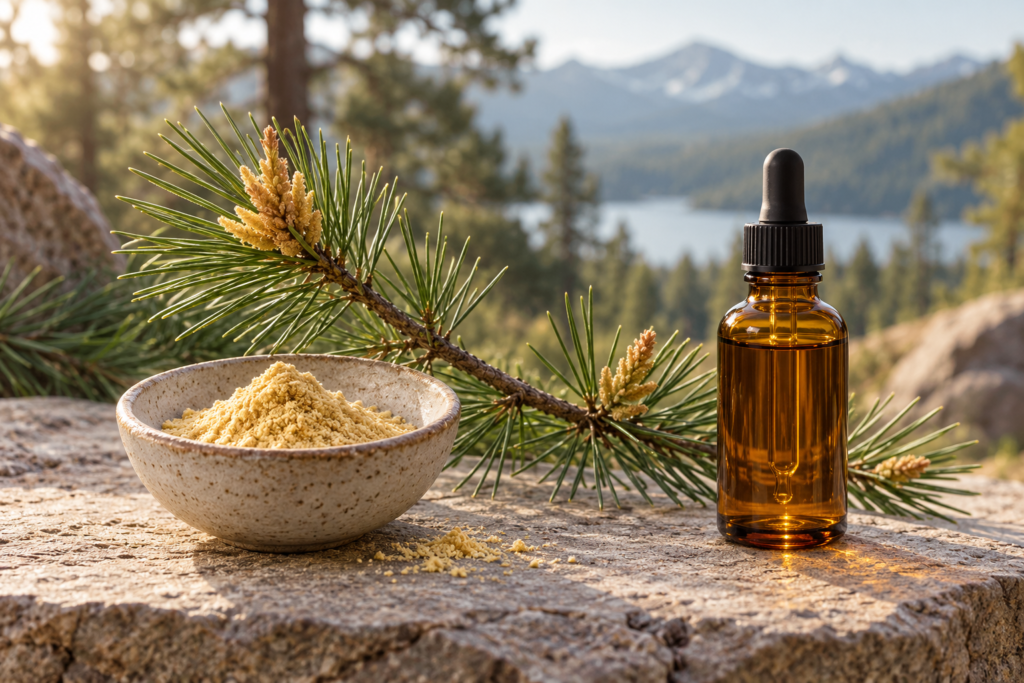
On one shelf, you may find a jar of fine golden powder. On another, a small amber bottle of pine pollen tincture. Both may originate from the same pine species—often Pinus massoniana, or Masson pine—yet they are not simply different ways of packaging the same material.
One provides the physical pollen itself. The other provides an extract containing compounds that were soluble under the conditions used to produce it.
That distinction is the key to understanding pine pollen powder versus tincture. If you are trying to decide between the two, the useful question is not necessarily, “Which one is stronger?” A better question is: What exactly does each preparation contain, and what do you want from it?
Key Takeaways
- Pine pollen powder contains the physical pollen material; a tincture contains compounds extracted from pollen into a liquid.
- Powder and tincture are not chemically identical preparations.
- “Cracked-cell” describes a processing method, not proven potency or a guaranteed health effect.
- A tincture’s composition depends on its solvent, extraction ratio, temperature, time, and other production variables.
- Powder retains more of the whole-pollen matrix, while tincture removes much of the insoluble bulk.
- Direct human evidence comparing the absorption or effects of commercial pine pollen powders and tinctures appears to be very limited.
Table of Contents
- Start With the Tree, Not the Bottle
- Pine Pollen Powder Keeps the Whole Material
- The Tough Little Shell Around a Pollen Grain
- What Does “Cracked-Cell” Pine Pollen Mean?
- A Tincture Takes a Different Route
- Powder Gives You the Pollen; Tincture Gives You an Extract
- Extraction Is Selective
- Does Tincture Mean More Concentrated?
- Powder Naturally Includes More of the Whole-Pollen Matrix
- Tincture Removes Much of the Bulk
- What About Alcohol?
- Which Form Is More Bioavailable?
- Powder vs. Tincture at a Glance
- Which One Is Better?
- The Label Tells You More Than the Format
- Neither Form Fixes Poor-Quality Starting Material
- The Most Useful Way to Think About the Choice
- Frequently Asked Questions
- References and Further Reading
Start With the Tree, Not the Bottle
Pine pollen is the reproductive pollen produced by male cones of trees in the genus Pinus.
Several species may be used, but two names appear frequently in Chinese botanical traditions and modern literature: Pinus massoniana, commonly called Masson pine, and Pinus tabuliformis, often called Chinese pine or Chinese red pine.
Fresh pollen is microscopic, but when millions of grains are collected together, they form the familiar fine yellow powder. At that stage, the pollen is still a whole botanical material.
What happens next determines whether it becomes a powder, a processed powder, or an extract. For a closer look at the botanical sources, read Which Pine Species Are Used for Pine Pollen?
Pine Pollen Powder Keeps the Whole Material
Pine pollen powder is the most straightforward preparation.
The pollen is collected, cleaned, dried, and packaged in powdered form. Depending on the product, it may also undergo additional milling or treatment intended to disrupt the pollen wall.
Because powder contains the physical pollen material, it retains a broad mixture of naturally occurring constituents. Research has identified pine pollen as containing varying amounts of:
- Proteins and amino acids
- Carbohydrates
- Polysaccharides
- Lipids and fatty acids
- Minerals
- Phytosterols
- Phenolic compounds
- Flavonoids
- Other naturally occurring constituents
The exact composition is not universal. Species, growing conditions, harvest timing, processing, drying, and storage can all change the final material.
That is one reason to approach products described simply as “pine pollen” cautiously when the species and processing method are not identified.
The Tough Little Shell Around a Pollen Grain
One feature makes pollen especially interesting from a processing perspective: its outer wall.
Pollen grains are designed to travel through the environment without immediately falling apart. Their protective wall includes an exceptionally durable outer layer called the exine.
You do not need to remember the botanical terminology to understand the principle. Think of a pollen grain as a microscopic package built to protect its contents while wind carries it from one part of the forest to another.
That toughness is useful to the pine tree. For people processing pollen as food or supplements, however, it raises an obvious question: should that protective structure be physically disrupted?
This leads to one of the most common terms in the pine pollen market.
What Does “Cracked-Cell” Pine Pollen Mean?
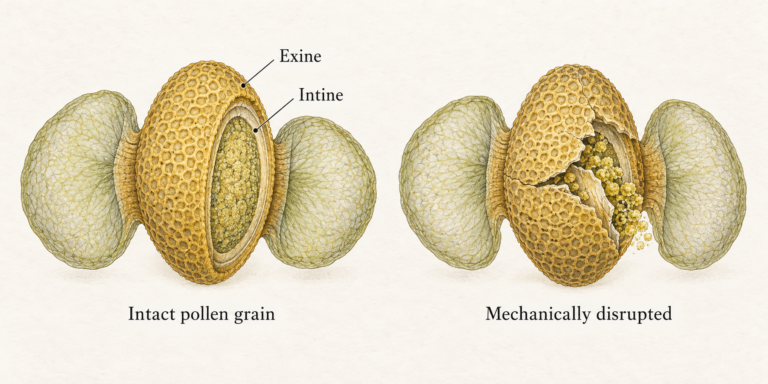
You will often see pine pollen powder advertised as cracked-cell, broken-cell, or cell-wall-broken pollen. These are commercial processing terms rather than precise botanical descriptions. They generally indicate that the pollen has undergone mechanical processing intended to disrupt its protective wall.
Botanically, the pollen wall includes an outer layer called the exine and an inner layer called the intine. In product descriptions, however, “cracked-cell” is commonly used as shorthand for processed pollen.
Various physical methods can be used to alter pollen structure, including very fine grinding and other forms of mechanical treatment. Once processed, the powder may look almost identical to ordinary pollen when viewed with the naked eye. The difference is microscopic.
Manufacturers often claim that cracking the pollen dramatically improves absorption. That sounds plausible in principle, but it is important not to turn a processing description into a clinical conclusion.
Published reviews describe how post-harvest processing can alter the physical and chemical characteristics of pine pollen. That does not mean every cracked-cell product has been shown to produce a specific improvement in human absorption or health outcomes.
Treat cracked-cell as useful product information—not as proof of potency by itself.
A Tincture Takes a Different Route
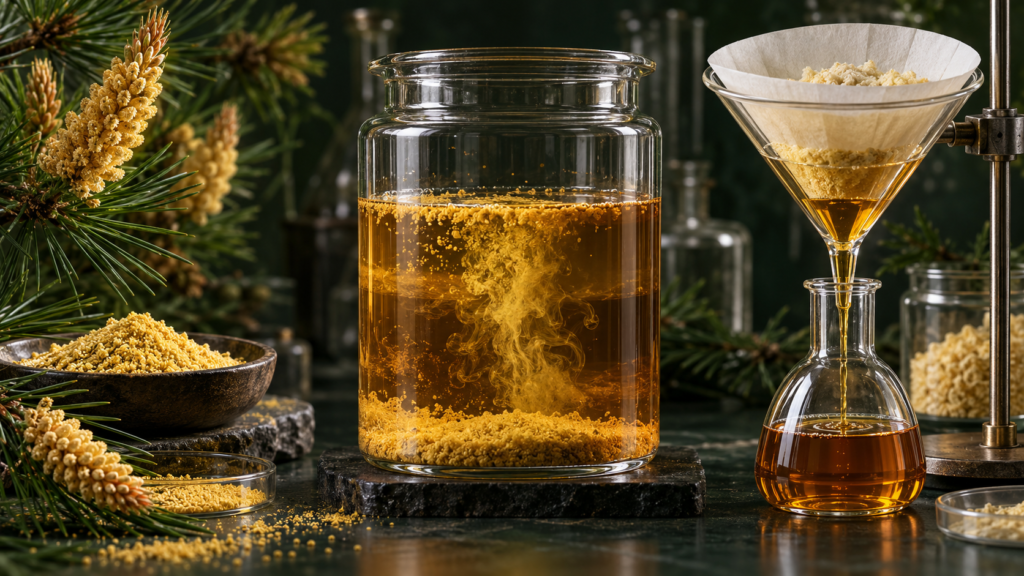
A pine pollen tincture begins with pollen, but the finished filtered extract does not retain the complete pollen matrix.
Instead, pollen is placed in a liquid solvent. Traditional herbal tinctures commonly use ethanol and water in combination. The mixture is often described simply as alcohol, but the presence of water matters because different botanical compounds have different solubilities.
Some compounds dissolve more readily in water, while others are more soluble in alcohol. Combining ethanol and water can extract a broader—or simply different—range of compounds than either solvent alone.
During extraction, compounds that are soluble under those conditions move from the pollen into the liquid. The solid pollen is eventually separated from the extract. What remains is the tincture.
Powder Gives You the Pollen; Tincture Gives You an Extract
This is probably the single most useful distinction on this page.
Pine pollen powder contains the botanical material itself.
Pine pollen tincture contains compounds extracted from that botanical material into a liquid.
They should not be viewed as chemically identical preparations.
Imagine making coffee. Whole coffee beans, ground coffee, and brewed coffee all originate from the same plant material, but a cup of brewed coffee does not contain everything that existed in the original bean. Water selectively extracts certain compounds.
The same basic idea applies to herbal extraction. A tincture represents the fraction of the starting material that was soluble under the particular extraction conditions used.
Extraction Is Selective
Pine pollen contains compounds with very different chemical properties.
Some components are readily extracted with water. Researchers studying Pinus massoniana pollen polysaccharides, for example, have used hot-water extraction followed by ethanol precipitation and additional purification steps to isolate particular polysaccharide fractions.
That laboratory procedure is very different from a commercial tincture, but it illustrates an important principle: different extraction methods isolate different portions of the pollen.
Alcohol concentration, water content, temperature, extraction time, particle size, and the ratio of pollen to solvent can all influence an extract.
Two pine pollen tinctures are therefore not necessarily equivalent simply because both bottles say “pine pollen.” The extraction method matters.
Does Tincture Mean More Concentrated?
Not automatically.
A tincture may contain a concentrated amount of certain extractable compounds relative to its serving volume. But describing it simply as “more concentrated pine pollen” is misleading. It may contain more of some compounds and much less—or effectively none—of others.
The concentration also depends heavily on how the tincture was made. A transparent tincture label or supporting product documentation may provide information such as:
- Pine species used
- Plant material used—in this case, pollen
- Amount or weight of starting pollen used
- Extraction ratio, when applicable
- Extraction solvent and its alcohol concentration, when disclosed
- Other ingredients
- Serving size
Without that information, terms such as maximum strength, ultra potent, or highly concentrated tell you surprisingly little.
Powder Naturally Includes More of the Whole-Pollen Matrix
Whole or cracked-cell powder has one obvious advantage: it preserves much more of the starting botanical material, including substances that may not dissolve efficiently into a hydroalcoholic tincture.
Proteins, structural carbohydrates, lipids, and other physical components remain present in the powder rather than being intentionally separated during filtration.
For someone interested in pine pollen primarily as a whole botanical food material, that distinction may be important. Powder is much closer to the original harvested pollen.
Tincture Removes Much of the Bulk
A tincture takes the opposite approach.
Instead of taking the complete pollen matrix, a tincture provides a relatively small amount of liquid containing compounds that were soluble under the extraction conditions.
There is no spoonful of powder to mix into water, yogurt, smoothies, or food. A small measured serving can be taken directly. That convenience is one of the clearest practical advantages of tincture preparations.
It should not be confused, however, with proof that the tincture is biologically superior. Convenience and effectiveness are different questions.
What About Alcohol?
A traditional tincture contains alcohol because ethanol is an effective botanical extraction solvent. Commercial tinctures commonly use a mixture of ethanol and water rather than pure alcohol.
The final alcohol concentration varies considerably between products and extraction methods. For some people, that is acceptable. Others prefer or need to avoid alcohol because of personal preference, religious considerations, pregnancy, medication use, recovery from alcohol-use disorder, or other circumstances.
Those readers may find powder—or an appropriately formulated alcohol-free extract—more suitable. An alcohol-free liquid, however, may not have the same extraction profile as a hydroalcoholic tincture.
Check the ingredient statement and product documentation rather than assuming every liquid botanical product contains the same amount of alcohol.
Which Form Is More Bioavailable?
This question deserves a careful answer.
There is a tendency in supplement marketing to describe one preparation as automatically “more bioavailable” than another. The reality is more complicated.
Disrupting the pollen wall may make some constituents more physically accessible, but greater physical accessibility does not automatically establish greater absorption in humans. Extraction can also place certain compounds into solution before they reach the digestive system.
Bioavailability is compound-specific. A process that improves access to one component may do little for another.
More importantly, direct human evidence comparing the bioavailability of commercial pine pollen powder and pine pollen tincture appears to be very limited.
Statements such as “tincture is absorbed X times better than powder” should be treated cautiously unless they are supported by evidence specific to the preparation and compounds being discussed.
Powder vs. Tincture at a Glance
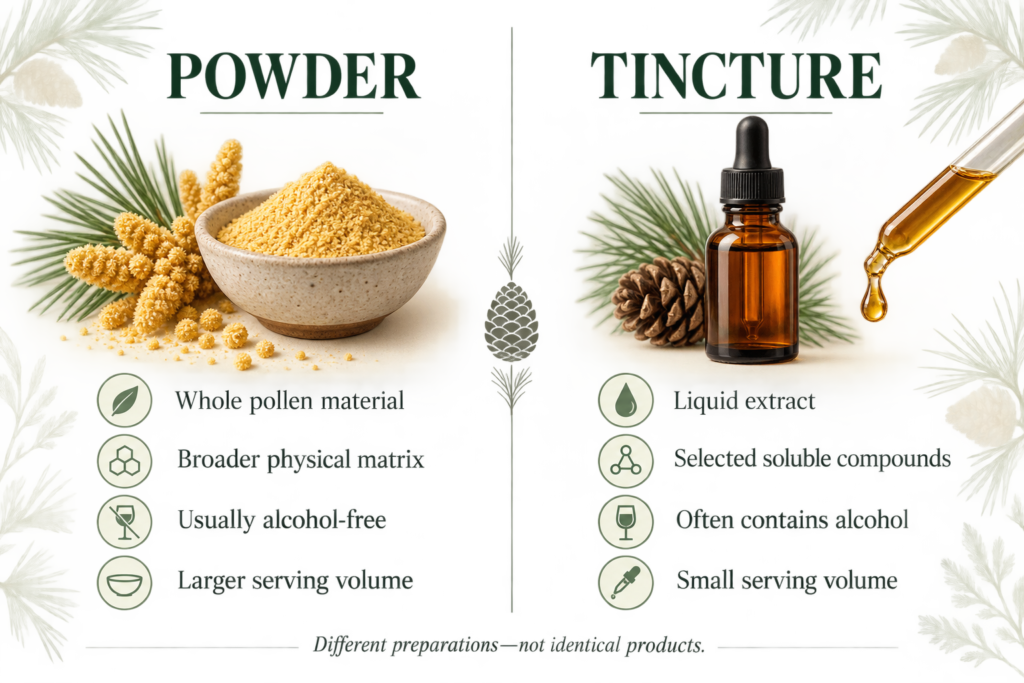
Pine Pollen Powder
Best described as: the actual dried pollen material.
Potential advantages:
- Retains a broad whole-pollen matrix
- Can be mixed into foods or drinks
- Usually contains no extraction alcohol
- May be available as whole or cracked-cell pollen
- Closer to the original harvested botanical material
Things to consider:
- Can be messy
- Has a distinctive taste and texture
- Powder servings generally involve a greater physical volume than tincture servings
- Quality depends heavily on cleanliness, processing, and storage
Pine Pollen Tincture
Best described as: a liquid extract made from pollen.
Potential advantages:
- Convenient, small-volume servings
- No powder texture
- Certain extractable constituents are already present in solution
- Easy to measure
- Stores conveniently in a small bottle
Things to consider:
- Does not contain the entire pollen matrix
- Extraction method strongly influences composition
- Typically contains alcohol unless specifically formulated otherwise
- Products may vary substantially in pollen-to-solvent ratio
- “More concentrated” does not necessarily mean universally more effective
Which One Is Better?
There is no scientifically defensible universal winner. The answer depends on what you are trying to consume.
If your goal is to use pine pollen in something close to its whole botanical form, powder may make more sense.
If you prefer a small-volume liquid containing compounds selectively extracted into alcohol and water, tincture may be the more practical format.
Some people use both, but that does not automatically provide an additional benefit.
In practice, the more useful question is not “Which is strongest?” but “Which preparation is better documented and better suited to what I actually want?”
That keeps the decision grounded in the product itself rather than advertising language.
The Label Tells You More Than the Format
Whether you choose powder or tincture, pay close attention to what the manufacturer actually tells you.
A good pine pollen product should make basic questions easy to answer. Look for:
- Botanical species: Is it Pinus massoniana, Pinus tabuliformis, or another species?
- Plant material: Does the label clearly identify pollen?
- Processing: Is the powder whole or cracked-cell?
- Extraction details: If it is a tincture, what solvent and ratio were used?
- Alcohol content: Is it clearly disclosed?
- Origin: Is the source of the pollen identified?
- Testing: Has the finished material been tested for contaminants?
- Ingredient transparency: Are fillers, carriers, sweeteners, and other ingredients disclosed?
- Realistic claims: Does the company distinguish scientific evidence from marketing?
Those details are far more informative than a large “PREMIUM” or “EXTRA STRENGTH” banner on the front of a bottle.
Neither Form Fixes Poor-Quality Starting Material
Excellent extraction cannot turn poorly identified or contaminated pollen into an excellent botanical product. Likewise, disrupting the pollen wall does not compensate for poor harvesting, improper drying, careless storage, or questionable sourcing.
Quality begins before processing.
The pollen should come from a correctly identified pine species, be harvested and handled appropriately, and be protected against contamination and moisture. Only then does it make sense to debate powder versus tincture.
The Most Useful Way to Think About the Choice
Pine pollen powder and pine pollen tincture start with the same botanical material, but they take different paths after harvest.
Powder keeps the pollen. Tincture extracts from it.
If you want the broad physical material produced by a pine such as Pinus massoniana, powder is the more direct expression of the plant. If you want a compact liquid preparation containing compounds soluble in the chosen extraction system, tincture offers a different approach.
Neither label alone tells you which product is better. Species, processing, extraction method, purity, testing, and transparency still matter.
Powder and tincture are not competing versions of an identical substance. They are distinct preparations, and choosing between them becomes easier once you understand what each one contains—and what each one leaves behind.
To understand how liquid extracts are prepared, continue with What Is a Tincture?
Frequently Asked Questions:
Is pine pollen powder the same as pine pollen tincture?
No. Powder contains the dried physical pollen material, whether whole or mechanically processed. A tincture contains compounds that moved from pollen into a liquid solvent and remained after the solid material was filtered out. They begin with the same botanical source but do not retain the same chemical profile or physical components.
What does cracked-cell pine pollen mean?
“Cracked-cell” is commercial shorthand for pollen that has undergone mechanical processing intended to disrupt its protective wall. The term does not identify one standardized method, and it does not by itself prove a particular improvement in absorption or health outcomes. Look for specific processing information and supporting evidence rather than relying on the phrase alone.
Does a tincture contain the complete pine pollen grain?
Generally, no. During tincture production, soluble constituents move into a liquid solvent. The remaining solid pollen material is then separated from the extract. The finished tincture therefore represents an extracted fraction of the starting material rather than the complete pollen grain and its entire matrix.
Is pine pollen tincture more concentrated than powder?
It may be concentrated in certain extractable compounds relative to its serving volume, but “more concentrated” does not mean it contains more of every component found in pollen. Meaningful comparison requires information about the starting material, extraction ratio, solvent, and serving size. Without those details, concentration claims are difficult to interpret.
Which form is better for someone avoiding alcohol?
Powder is generally the more straightforward choice because it usually does not contain extraction alcohol. Alcohol-free liquid extracts may also be available, but they can have a different extraction profile from hydroalcoholic tinctures. Anyone avoiding alcohol for medical, pregnancy-related, religious, recovery, or medication reasons should check the label and consult an appropriate professional when needed.
References and Further Reading
- Cheng Y, et al. “Pine pollen: A review of its chemical composition, health effects, processing, and food applications.” Trends in Food Science & Technology. 2023;138:599–614. View DOI record
- Yang S, et al. “Antioxidant and Immunomodulatory Activities of Polysaccharides from Pinus massoniana Pollen.” PLoS ONE. 2015. View full text
- Li F-S, et al. “The origin and evolution of the pollen exine.” Nature Plants. 2019. View PubMed record
- Plaskova A, Mlcek J. “New Insights of the Application of Water or Ethanol-Water Plant Extract Rich in Active Compounds in Food.” Frontiers in Nutrition. 2023. View full text
Editorial and Medical Disclaimer
This article is provided for educational and informational purposes only. It is not medical advice and is not intended to diagnose, treat, cure, or prevent any disease. Pine pollen products may not be appropriate for everyone. Consult a qualified healthcare professional before using a dietary supplement, particularly if you have allergies, are pregnant or breastfeeding, take medication, or have a medical condition.
PinePollen.org | Educational Article